Friday, 25 August 2017

Three Girls

This week, after almost a year, I completed my first transcription assignment for FreeCEN, the project to make all census returns for the nineteenth century available for researchers to search on line without cost.  It was all very interesting, because the places and many of the family names were familiar to me from childhood.  Not until it was finished did I learn that I’d been ‘thrown in at the deep end’, with one of the largest Pieces, well over 7,000 individual entries, covering ten towns and villages.  The last section was the easiest, because there were fewer items of information for each individual, but at the same time it was one of the saddest ... it covered the workhouse at Stradbroke.

It was certainly a place that no one wanted to go if they could possibly avoid it.  It was made so deliberately, to discourage people from taking advantage of ‘something for nothing’; if you’ve ever visited one of the workhouses that have been preserved as sites of ‘educational  tourism’ - for example those at Gressenhall in Norfolk or Southwell in Nottinghamshire - it’s easy to imagine how well they fulfilled that aim.

As I wrote down the names of the 160 people recorded in this particular institution in north Suffolk, and against each one noted their marital condition, their gender and age and the sinister word ‘inmate’, I found myself wondering why it was each was there.   I spotted the odd married couple, but most of them were either widowed or were quite young, or children.  Had they just fallen on bad times, unable to get work, or were there more acute reasons?

One trio in particular stuck in my memory, and once the task was finished and submitted, I decided to do a little digging into the records in an attempt to piece together the story of these three girls named Roberts.  Clara was 4, Mary 3 and (the one that caught my eye in the first place) Eliza, only 12 days old.  There was nothing on the page to indicate that they were sisters ... just the fact that they were all together.  Where was their mother ... their father?  Had they parked their children there because there was no one else to look after them while they tried to provide for their tiny family?  With no obvious answers I came back to the fact that, only twelve days ago, this young woman had given birth.  She wouldn’t be out working .. but she wasn’t there in the workhouse either.

Finding baby Eliza’s birth registration on the GRO’s new birth register search website told me her mother’s maiden name – Moss – and the marriage register index showed that George Roberts and Eliza Moss had married in the June quarter of 1860.  There was no sign of them as a family in 1861’s census, however.  I did find Eliza, living with her parents and two young siblings in the village of Wingfield, conspicuously under her new married name and described as ‘married’, but with no husband present.  She was described as a ‘dealer’s wife’.  I couldn't find any trace of George after his marriage.

I found the family again in 1871, still in the same place: Eliza’s parents, her young brother now a 12-year-old scholar, and an Emily Roberts, described as ‘granddaughter’, aged 9.  This Emily was shown as born in her grandparents’ village, The workhouse entries showed Clara and Mary born in nearby Syleham.  No birth registration could be found for any of these three: Emily, Clara or Mary.  However, each was baptised in Wingfield: Emily at ten days old, Clara and Mary together when Mary was about three months.  In each case the child was described as the ‘daughter of George and his wife Eliza, late Moss’.

Childbirth was a hazardous business in those days.  If Eliza had been living apart from the family with her two younger daughters, making her own living as best she could, her body was probably not in the fittest condition to survive another birth.  I checked the death registers; sure enough, her death was recorded in the June quarter of 1871, aged 29.  The burial register confirmed my suspicions.   It showed that she was buried in Wingfield on 25th March, just four days after her little girl was born.  My guess is that she never recovered from the birth; the workhouse authorities probably had her parents noted as next of kin, and the burial took place as soon as arrangements could be made.  The register gave her home as Syleham.

There is a happy ending to the tale, however.  I decided to see what happened to the three girls in the next ten years.  In 1881, I found them in the nearby village of Weybread at the unlikely - but clearly identified - ‘Holiday House’.  Here lived James and Anna Ablett, tile maker and laundress, along with their nephew, George Leggett, also a tile maker.  Living with them were Mary Jane and Eliza Roberts, aged 12 and 10, described as orphans and scholars.  And who should be visiting on census night but Clara, described as a 17-year-old domestic servant (although she was actually only a month over fifteen .. not an infrequent occurence).  Eliza’s birthplace was correctly shown as Stradbroke, but the other two gave Wingfield, their grandparents’ home ... putting the past behind them?

Friday, 18 August 2017

I Blamed the BBC - Thank You, BBC!

Facebook is a wonderful facility.  Day after day, it seems, it can present to the user a reminder of what was happening a year, three years, any number of years ago, offering the chance to share these memories with friends again. Last weekend, I was reminded of a journey to Great Yarmouth a year ago and the recollection of a day at the seaside prompted the decision to go to another resort before this summer is out.  With nothing else demanding my time this week, I selected Tuesday for a trip to Lowestoft.

Tuesday began early.  After my weekly bell-ringing practice on Monday evening, and a follow-up drink with two friends in the pub across the road, I returned home to 'put social media to bed' before heading for the sheets myself.  As a result, an e-mail that had arrived during the evening was stuck in my mind and I didn't sleep well at all.  In short, at 3.0 I was sitting at my desk in my dressing gown and typing a reply.  I returned to bed an hour later and slept soundly until 8.30.  Consequently, by the time I actually left for the seaside the clock had just ticked past 10 o'clock.

I was listening to the radio as I drove along the A14 and, whatever the programme was, it so gripped my attention as I passed Bury St Edmunds, that it wasn't until I was going up the hill and rapidly approaching the next junction, that I realised I'd missed my turning.  I rapidly re-calculated my route and decided that it would be rather nice to go cross-country and approach Lowestoft from the south instead of the west. All went well until I'd started heading north on the A12.  I passed a turning signposted Dunwich and, by the time I'd reached a suitable place to turn around, I'd realised that time was passing, Lowestoft was still a long way to go and there was just as much coastal attraction a little closer.  So Dunwich it would be.

Dunwich: view from the cliff-top
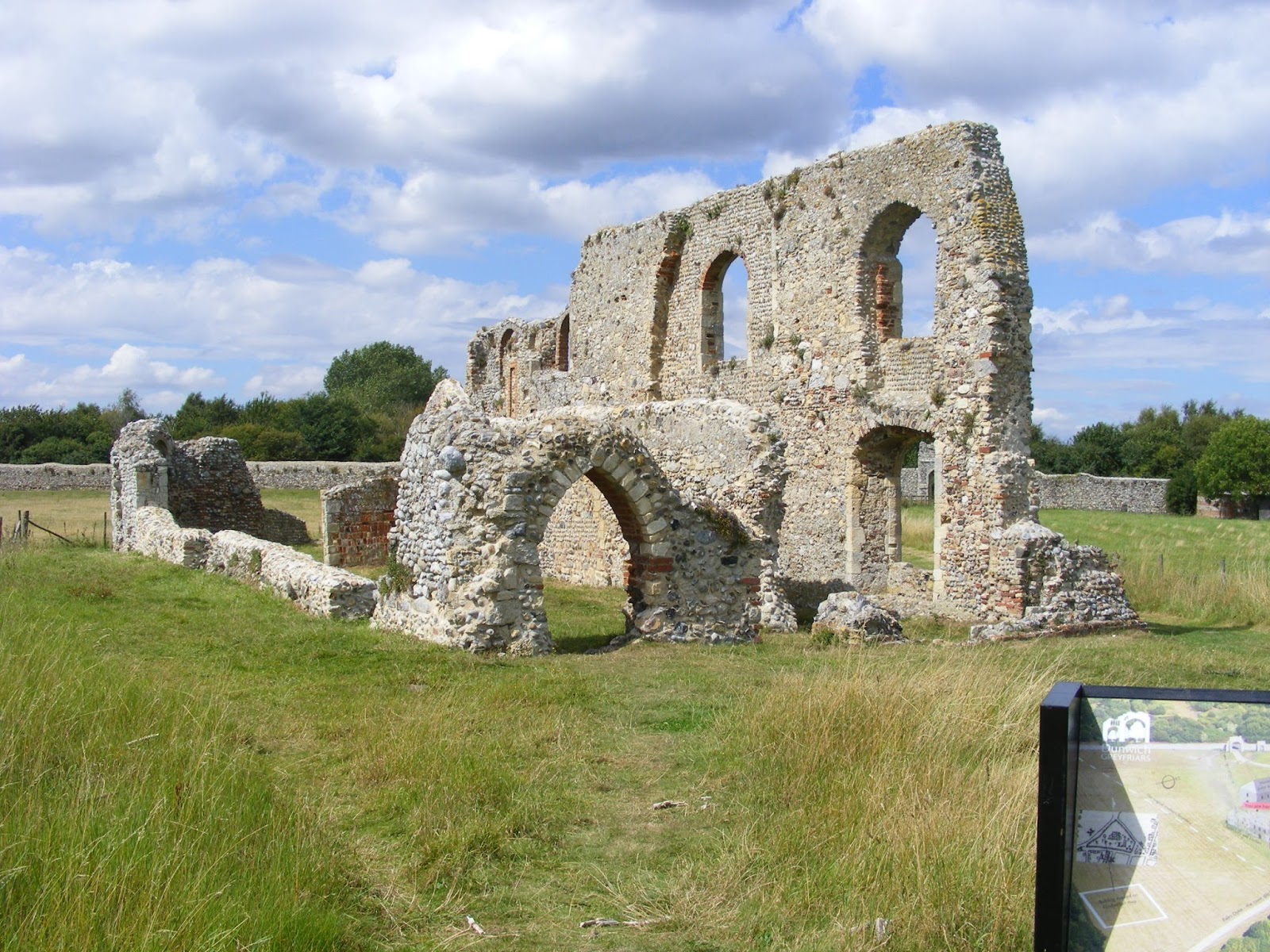
Parking there is essentially free, but subject to a donation, and the same conditions apply elsewhere.  After lazing a while on the beach I looked around the museum and walked up the hill to the ruins of Greyfriars Priory, returning to the seaside car park by way of a footpath along the cliff-top.  All too soon it was time to set off for home, deciding to take a more direct route than I'd come, but there was more excitement to come.
Ruins of Greyfriars Priory
I explored a few Suffolk villages that were new to me, and then found myself on the road that I would have used if I'd set off in the morning with the intention of visiting that one-time great port, now mostly submerged beneath the sea.  Soon I was approaching the turning to the village where I lived for six years or so at the end of the '70s and start of the '80s, and which was my spiritual home for well over twice that.  This time I made the decision soon enough, and diverted to indulge in a little nostalgia.  After walking around the corner where I had lived, rekindling memories, I wandered up the hill to the church.  Attracted by a roadside sign, 'Church Open', I crossed over and went inside.

To my amazement quite a number of people were gathered, and a table was being set out for refreshments.  As I turned towards a voice I recognised, and began to chat to the churchwarden, I noticed a woman looking at me with an undue sense of awe.  The truth then dawned and she apologised for her gaze.  "We're expecting a Bishop," she explained, and my friend pointed to a notice about the imminent visit of the diocesan eminence as part of an area event.  The ice was broken, and a spirit of friendship and fellowship enveloped me as I explored and enjoyed re-discovering things I'd forgotten.
Rt. Rev. Graham James,
Bishop of Norwich

As I returned to the gathering by the door, I found my eye returning to one particular young lady.  People were arriving all the time and minutes later, I noticed in the doorway a woman whom I recognised as the mother of the girl I saw in the young lady's face.  After greeting her and sharing the observation that we hadn't changed except for the colour of the thatch, I gestured and asked, "Is that young lady your daughter?"  "Yes," and provided her name.  Overhearing this, the younger lady addressed her mother, "Is that who I think it is?" and then, on receiving in return the same courtesy, greeted me personally.  I was flattered, since the last time she would have seen me she would have been no more than early teenage.

This very delightful experience lasted no more than half an hour but, as I later reviewed the day, I realised that none of these happenings had been planned, and I later learned that, had I made the right turn in the morning, I would have been delayed by an accident on the road.  And thinking further about the Bishop, as this picture shows, the only resemblance is the hair colour and the presence of spectacles.  The inappropriate association has to have had something to do with my wearing of a purple polo shirt behind the cross that is always around my neck.

Friday, 11 August 2017

All Manner of Things Shall be Well!

(My title this week is from the 15th century mystic Julian of Norwich.)

After last week's achievements (which included passing on the book about Julian of Norwich), the upward trend to my life has continued.  My floors, for example, look - and somehow feel - clean since the arrival of the new 'toy'.  It's absolutely amazing the volume it can suck out of a carpet and, it being bag-less and with a transparent storage body, I can see just how much unseen detritus I've been living on top of!

The highlight of the week was the day-trip to St Helen's on Wednesday.  In some ways it felt like being at work again, with lots of googling preliminaries, getting familiar with how the target area looks, deciding the best approach, and so on.  Twenty-four of us made this pilgrimage, in varying vehicular combinations and, I suspect, with a similar spread of motivation.  Some went just for the experience, some to see exactly what would happen, some to honour the past and others to join in pledging the future.  The occasion was the induction, installation and licensing of our former vicars into their new posts.

Although not the first such ceremony I've attended, it was the first time I'd been to 'an away event', my previous experiences having been limited to welcoming a new priest into my own church.  We are a church with bell-ringers but no bells; it's a pipe-dream for me that one day that we would join with the ringers of another place to celebrate together the movement of a priest from our parish to theirs.  Such a project was a non-starter in this instance because, like our church, St Nicholas, Sutton has only the one bell (although from its sound it's much bigger than ours!).

During their seven-year ministry with us in Letchworth, strong feelings have grown between our former vicars and ourselves, bonds of affection that will not be easily cast aside.  It was a poignant moment when, hearing them praying for the people they will now be serving, I realised that a new era has now begun for them.  Once the Church of England's strange processes have worked their course a similar new era will begin for us; for our part we can now feel that, in reality, that process has begun.

But the week has contained other high spots for me, too.  One of my regular morning prayer guides this week featured the work of the organisation in Wales and the introduction was written in both English and Welsh.  I was pleased that I could now with some fluency read the Welsh version and, although many of the words themselves are beyond the vocabulary I've so far acquired, I could follow the sentence structure and syntax of the whole piece.  It's an encouragement to persevere, and echoes a fact that I've noticed more and more lately, that 'England-and-Wales' is indeed a country with two languages and not just one.

About eighteen months ago, following a heavy cold, I realised that I had a problem with my nose that had not thereunto been the case.  Successive months saw numerous visits to doctors and specialists to determine what the problem was, and what might be the remedy.  Earlier this year I was led to believe that it was a further, if unwelcome, development of my asthma and that I should just have to live with it.  In recent weeks, I've become increasingly frustrated by the prospect of living the rest of my life with broken sleep, feeling tired, and so on, and yesterday I took time out to investigate further, using the wonders of the internet.

I found a forum on which were several posts describing symptoms and experiences the same as mine, and a number of medical responses, including references to remedies that I'd been prescribed during the past year and more.  I came to the conclusion that there could be a better, and simpler, way forward than the one I have been following.

At the same time, I recalled a small item that I had, tucked away in a kitchen drawer.  I have no idea how it came to be there and - until now - no idea precisely what it was for.  It bears the name Rovipharm and I now learn, from the same trusty internet, that it is indeed a medical syringe and comes from eastern France, near Lyon.  This little device certainly meets well the use to which I put it last night, for a saline douche, as a result of which I had the best night's sleep for months.  It was not uninterrupted, but a in a different league so far as satisfaction is concerned!

Saturday, 5 August 2017

It all Started When it Ended!

What puzzle is this?  My logical reader will correctly conclude that the two instances of 'it' in today's title must refer either to something cyclical or else to two different things.  It is a funny old word, isn't it?  Though I sometimes go over things enough times to be thought of as cyclical - at least, repetitious - in this instance there are indeed two things.

That which was ending is my holiday, which came to a slightly premature conclusion on Friday evening, after a rainy but otherwise mercifully uneventful drive from Wrexham; that beginning is the remarkably achieving week now drawing to its close, the highlights of which I shall now relate.

The holiday had begun with a phone call saying that my bathroom would be redecorated while I was away, a fortunate coincidence that gave the decorator unhindered access, and allowed the paint smell to disperse to a great extent in my absence.  It (the holiday!) ended with a series of SMS exchanges on Thursday evening, as a result of which my bath was sealed the following day and new blinds fitted in kitchen and bathroom.

While I was away, I had made arrangements to give my old vacuum cleaner to a couple of sisters who are setting up home in the neighbouring town, so one of my first tasks on returning was to use it to clean up the inevitable post-decorating detritus before cleaning the cleaner and delivering it.  When I got round to replacing the cleaner on Tuesday, I decided to retain the box against any future need that might arise, so it was tossed on a pile of 'stuff' in the corner of my bedroom.

Meanwhile, I learned of a newly-widowed lady who was clearing out her late husband's office, by means of which I successfully acquired a free laminator. The result of this arrival was a small heap of unwanted items from emptying a drawer in which to store it.  While making arrangements for passing these on, I remembered that the pile in the bedroom, recently topped off by the cleaner box, had overbalanced and now leant with unseemly affection towards the wardrobe.  While in tidying mode, I decided to take my new cleaner, shut myself in the bedroom, and clear everything out of that corner, so as to more securely store those things that were to be retained.

More activity on the free-recycling website ensued.  Consequently, an unused artist set has found a happy new owner, someone has the means of storing seeds, one can enjoy the sunshine in her garden, and another can keep her feet dry on her allotment.  I also discovered a cork board that I had totally forgotten about, which now graces the wall in front of my desk, and hopefully will keep me more organised in future.  There are a few small items yet to be disposed of but, overall, I feel content at the conclusion of the tidying exercise.

One of the reasons for coming home a day earlier than planned from my holiday was the unexpected sum I had needed to spend to keep my car on the road, following a breakdown.  Scared that I would overspend, I decided to curtail the possibility of spending.  In the event I found I had over-budgeted and needn't have been so fearful but, as the accountant in me would always claim, 'better safe than sorry!'  I was still a bit worried about the car, so yesterday morning found me at the garage soon after they opened, seeking reassurance that all was well.  Happily, this was forthcoming.  It's good to have built up a good relationship with them while I was working, so I can enjoy such favours now.

The final blessing was the rain clearing this afternoon so that I felt comfortable going to watch one of the new season's early FA Cup ties.  It wasn't a great day for local teams.  The tie nearest to my home saw Stotfold lose 12-1 to Berkhamstead.  I went to my usual ground a few miles up the A1 and saw Biggleswade FC lose 4-1 to Wisbech Town.  Although they are playing in different leagues at the same level this season, the home team have just been promoted after only one season of senior football, while the visitors have a long history, and got to the quarter finals of the FA Vase only three years ago.  My 'native' team, Diss Town, now playing one division lower, also lost, by 5-0 to Great Yarmouth Town.  With all the Cup excitement thus over for the present, most league campaigns start during the coming week.


Saturday, 29 July 2017

Thinking About What's Important

If it hadn't been booked and paid for in advance, I probably wouldn't have gone!  After my holiday began with three days of wall-to-wall sunshine in which my arms enjoyed unaccustomed naked freedom, Wednesday dawned decidedly damp.  Once I'd admitted some fresh air to my room, the throb of rain on the roofs below my second-floor window competed with the constant rumble of traffic on the trunk road only a mile or so away.

Instead of what might have been preferred: a morning in my room reading or writing while waiting to see if the weather would clear, I was quickly on the road.  An 84-mile journey in the rain, on roads I didn't know, took me to Aberystwyth and Rheilffordd cwm Rheidol, the Vale of Rheidol railway. With the delightful scenery obscured by mist, and the discouraging dampness all around, my camera stayed firmly in its case, giving me a great opportunity for ... I was going to say 'nothing' but, in truth, it was a wonderful chance to think.

We had scarcely left the station when we encountered the first crossing, where the gates had to be operated from afar by the fireman.  Once the barrier had been lowered, the train crossed in front of the stationary traffic, but not without a great deal of whistling.  The same was even more the case at the next crossing, where there were no gates at all.  With amazing frequency, as the journey progressed, there were further whistles as we passed one after another of the tiniest tracks that appeared to go nowhere ... and often appeared from nowhere, too!

At one point we passed a small tent in a clearing; I thought of how its inhabitant might be living and recalled reading, perhaps thirty years ago, a book by Milan Kundera, in which he asked what was important to man.  To the best of my recollection, Kundera posited three essentials: shelter, food and sanitation; provided these three needs were met, he said, a man could find happiness.  Although I can see his point, I readily admit that I've grown up in a world where I cannot imagine life peeled back to just these basics. Our western civilisation leads us to require much more, by way of warmth, a selection of clothes and a choice of food.  The food has to be cooked, of course, and so there's a need for heat and suitable receptacles.  And in recent years, an internet connection has also become almost indispensable.

In the light of this, I compared my holiday facilities with those of whoever was using that tent. My experience this week has been in a hotel that seems scarcely to operate as one.  There are no meals; 'reception' is an untidy and unmanned desk, and the only staff presence seemed to be behind the bar.  It was almost like being in a self-catering bed-sit.  As I reflected on how much I was doing for myself, I thought again of the hardships of daily life experienced by communities in the villages and hamlets I was passing in the train.  Many of the houses within sight of the railway had cars parked nearby, so they must have access other than by the railway, although how this was effected wasn't obvious.

I wondered why the railway had been built in the first place.  In most cases the mid-19th century brought the trains to replace stagecoaches, providing a faster and (eventually) more comfortable alternative means of getting from one centre of population to another.  This railway didn't start until 1897, though, and as to replacing a stagecoach ... on this mountainside?  Shanks's Pony, more like! Those tracks where we whistled so carefully as we passed must have come from some small settlement, and they must lead somewhere.  But they're still there, and still used too; so to what extent has the railway eased the lives of the people here?  Or is the purpose solely to develop the world of the recreational walker, and advance the tourism industry?

My thoughts kept going back to those isolated farms and cottages.  Perhaps my mind is drawn by the Welsh book I'm reading (paragraph by painful paragraph as I learn yr iaith Gymraeg), about a community that was completely wiped out by the winter of 1947.  In past ages, at least, and still today in many ways I expect, they had to be virtually self-sufficient.  If we were living there instead of in our modern towns and cities, would we find ourselves re-inventing the things we presently depend upon?  Or would we grow accustomed over a period of time to a simpler way of life?

And, while for the present, this question is purely hypothetical, is this something that may come to many of us post-Brexit, as some features disappear from our daily lives, or at least become so terribly expensive as to become luxuries instead of essentials?

Friday, 21 July 2017

Plough the Furrow, Sow the Seed, Reap the Harvest

(For my title this week I'm indebted to author Margaret Dickinson ... these three form an excellent trilogy.)

It's long baffled me why churches celebrate their harvest festivals in early October ... or at best late September.  My childhood recollections, supported by what I've seen driving through the countryside in more recent years, tell me that harvest begins in mid-July and is over by mid-August in most places.  Equally recent social history research, however, suggests that, at the time when harvest festivals were being developed, harvest was a much more labour-intensive and long-drawn-out affair than it is today.

However, quite apart from the field of agriculture, this is a time for celebrating the reaping of other harvests sown earlier in the year. Schools are on the brink of breaking up for that long summer break; quite recently we saw pretty girls parading their finery in readiness for prom nights - what used to be 'end of school parties' have moved up a league - and, higher still in the academic world, students galore have been celebrating the end of several years of study as they collect their degrees from universities up and down the country.

Many are looking forward to a well-earned break from routine in the form of an annual holiday.  I can remember my mother saving the shillings all through the year in order to pay for a week by the seaside.  By my early teens, it might have been boring for me, following what was a pre-set pattern year after year, but for her it was the one week in the year when she didn't have to prepare meals day after day, didn't have to think about running the home and all the other things that our pre-equality world demanded of a housewife.  It made all the scrimping and saving worthwhile.

Following the same pattern that I grew up with, I'm just embarking on a week away, but it won't be the oh, so familiar, Yarmouth again.  Instead there will be a different view each day and, although I shall be staying not far from the coast, excursions are planned to a variety of seaside resorts and inland tourist attractions as well.

This time of year is very much a crossroads for our emotions.  The other evening I went to a pre-season football match; it was good entertainment and 'my' team won.  A few years ago, I joined what was the largest football crowd of my watching career when I watched a non-league team playing League 4 Chesterfield in front of 1,200-plus.  It's the time for teams to test their mettle against bigger sides in readiness for the new season ... and the start of the 2018 FA Cup competition is only weeks away!

My week has seen the completion of more foundations for the future.  For over a year now, I have been arguing the case for the church to offer first aid training to key volunteers.  Once approval was given a few months ago, the effort moved to organising a training day.  This week, in a sudden burst, came the final selection of a date when all those involved can be available and the booking and confirmation of the course itself.

Also in our church, as in countless others, a small handful of parents, grandparents and other willing helpers are bringing to a conclusion their preparations for a Holiday Club event for the children of the church and the wider community.  Quite apart from any spiritual content, it will be a time of craft work, singing, games, and fun of all kinds, and is very popular every year.  To the parents of those children it will form part of a far larger plan, that of keeping the little darlings occupied with one activity after another during the long school holiday.

For some parents, this will be more of a challenge than for others.  Some children are quite adept at keeping themselves amused but - although I fully expect to be challenged on this - these are, I believe, more in the minority these days than, say, when I was a child in the middle of the last century. While many more activities are available for children in today's world, a lot of these need parental participation, or at least transport to get to them, so the parents become drawn into the demands of the school holidays in a way that was not the case in past ages.  As one commentator put  it, 'children no longer learn how to deal with boredom; they are spared from it by the plethora that surrounds them.'

And of course, a holiday gives the opportunity to plan ahead.  With the mind freed from past commitments now completed, or the routines that so often command the same energies, thought can be given to new projects to which attention can directed upon our return.  Whether the body is lazing on a sun-drenched beach, sheltering from rain-drenched gardens, or walking on dusty roads and pathways, the mind can be having its own adventure ... and who knows what delights might be in store for the unsuspecting holidaymaker upon his return to normality!

So, dear reader, whether you are celebrating a crop newly harvested, watching the growth of a crop recently sown, or ploughing the ground for a crop yet to come, do have a profitable and productive holiday when it comes.

Friday, 14 July 2017

What did Emma Think?

I don't know about you, but I do like a biscuit with my mid-morning coffee. I am privileged to keep my ready supply in an antique wooden biscuit-barrel. It bears a silver shield, inscribed "Silver Wedding 1937", and was a family gift to my grandparents.

The happy couple were married on the 12th October, 1912.  I wonder whether it was a happiness that was tinged with a streak of sadness for, according to family legend, it should have taken place during the spring of the previous year.  Sadly, James, the bridegroom's father, had died on 4th May at the early age of 53, after a long illness.

The 1911 census reveals that he was a farmer, and I would say that, despite his illness, he was a determined one at that.  Susannah, his well-meaning wife, had completed the first two lines of the census form in a neat feminine hand.  She provided details of the two of them and, perhaps with a degree of pride, declared that, in 27 years of marriage, she had borne him eleven children all of whom were still living.  James then took the pen and struggled to add the name of James William, his eldest son and trusted farm manager, and those of the seven other sons who were also living with them: three farm labourers, three scholars and the youngest - at four years old, was he Charles Henry or Henry Charles? - still at home.

Bridge Farm in 2011
Although the census form was addressed to Fen Street, the electoral registers for the period show James' residence, and voting qualification, clearly as Bridge Farm.  My mother left family photos that had been taken there, and it was still standing, albeit in a derelict state, until two or three years ago, when it was reduced to a shell by fire.

My grandfather, the aforementioned farm manager James junior, but always known as Jimmy, had been courting Emma for several years.  When his father died, he realised that his duty to his mother lay in keeping the farm running smoothly, however much he would have liked to be setting up his own home with Emma.
Bridge Farm after the fire

When they finally married, it isn't clear where they first made that home.  Susannah had moved out of the farm for, although not entitled then to vote in parliamentary elections, women were allowed to vote in local elections, and she appeared on the electoral register for 1913 living just down the road at a house in the tiny hamlet of Crackthorne ... while of Jimmy there is no mention.

By 1915, Susannah was still at Crackthorne, and Jimmy had appeared in a house on the village green.  Another uncertainty is the changes that had occurred at the farm during those years.  One possibility is that Jimmy had still been running it, although not actually living there.  In 1916, the younger two of those three 1911 labourers died on the Somme, John in September, Alfred in November, and the Commonwealth War Graves Commission records their next of kin as Susannah ... now at Bridge Farm again.

in the RFC: Jimmy is at the back
 on the right
Having claimed two of the brothers and, as the 1919 electoral register shows, with at least one more also in the services, the war rumbled on.  After another harvest, Jimmy decided - or a change in legislation required of him - that it was time to go.  Just a week before Christmas, 1917, he enlisted as Private 112539 in the Royal Flying Corps.  I wonder what Emma thought of that.  My mother was less than a year old.  With another infant at home, and pregnant with her third child, she must have been either resentful or very courageous in waving her husband goodbye at such a time when she would be needing him most.  By then they were living at Bridge Farm; I can only hope that she had family support around her.

Although I don't understand all of the military abbreviations, it seems that my grandfather never saw active service.  Having been moved from a training unit to what might be a commissioning squadron in December 1918, he was transferred to RAF reserve in February 1919 and his service record ends with the words, "Deemed discharged 30.4.1920".

There must have been sighs of relief all round.