If it hadn't been booked and paid for in advance, I probably wouldn't have gone! After my holiday began with three days of wall-to-wall sunshine in which my arms enjoyed unaccustomed naked freedom, Wednesday dawned decidedly damp. Once I'd admitted some fresh air to my room, the throb of rain on the roofs below my second-floor window competed with the constant rumble of traffic on the trunk road only a mile or so away.
Instead of what might have been preferred: a morning in my room reading or writing while waiting to see if the weather would clear, I was quickly on the road. An 84-mile journey in the rain, on roads I didn't know, took me to Aberystwyth and Rheilffordd cwm Rheidol, the Vale of Rheidol railway. With the delightful scenery obscured by mist, and the discouraging dampness all around, my camera stayed firmly in its case, giving me a great opportunity for ... I was going to say 'nothing' but, in truth, it was a wonderful chance to think.
We had scarcely left the station when we encountered the first crossing, where the gates had to be operated from afar by the fireman. Once the barrier had been lowered, the train crossed in front of the stationary traffic, but not without a great deal of whistling. The same was even more the case at the next crossing, where there were no gates at all. With amazing frequency, as the journey progressed, there were further whistles as we passed one after another of the tiniest tracks that appeared to go nowhere ... and often appeared from nowhere, too!
At one point we passed a small tent in a clearing; I thought of how its inhabitant might be living and recalled reading, perhaps thirty years ago, a book by Milan Kundera, in which he asked what was important to man. To the best of my recollection, Kundera posited three essentials: shelter, food and sanitation; provided these three needs were met, he said, a man could find happiness. Although I can see his point, I readily admit that I've grown up in a world where I cannot imagine life peeled back to just these basics. Our western civilisation leads us to require much more, by way of warmth, a selection of clothes and a choice of food. The food has to be cooked, of course, and so there's a need for heat and suitable receptacles. And in recent years, an internet connection has also become almost indispensable.
In the light of this, I compared my holiday facilities with those of whoever was using that tent. My experience this week has been in a hotel that seems scarcely to operate as one. There are no meals; 'reception' is an untidy and unmanned desk, and the only staff presence seemed to be behind the bar. It was almost like being in a self-catering bed-sit. As I reflected on how much I was doing for myself, I thought again of the hardships of daily life experienced by communities in the villages and hamlets I was passing in the train. Many of the houses within sight of the railway had cars parked nearby, so they must have access other than by the railway, although how this was effected wasn't obvious.
I wondered why the railway had been built in the first place. In most cases the mid-19th century brought the trains to replace stagecoaches, providing a faster and (eventually) more comfortable alternative means of getting from one centre of population to another. This railway didn't start until 1897, though, and as to replacing a stagecoach ... on this mountainside? Shanks's Pony, more like! Those tracks where we whistled so carefully as we passed must have come from some small settlement, and they must lead somewhere. But they're still there, and still used too; so to what extent has the railway eased the lives of the people here? Or is the purpose solely to develop the world of the recreational walker, and advance the tourism industry?
My thoughts kept going back to those isolated farms and cottages. Perhaps my mind is drawn by the Welsh book I'm reading (paragraph by painful paragraph as I learn yr iaith Gymraeg), about a community that was completely wiped out by the winter of 1947. In past ages, at least, and still today in many ways I expect, they had to be virtually self-sufficient. If we were living there instead of in our modern towns and cities, would we find ourselves re-inventing the things we presently depend upon? Or would we grow accustomed over a period of time to a simpler way of life?
And, while for the present, this question is purely hypothetical, is this something that may come to many of us post-Brexit, as some features disappear from our daily lives, or at least become so terribly expensive as to become luxuries instead of essentials?
Saturday, 29 July 2017

Friday, 21 July 2017
Plough the Furrow, Sow the Seed, Reap the Harvest
(For my title this week I'm indebted to author Margaret Dickinson ... these three form an excellent trilogy.)
It's long baffled me why churches celebrate their harvest festivals in early October ... or at best late September. My childhood recollections, supported by what I've seen driving through the countryside in more recent years, tell me that harvest begins in mid-July and is over by mid-August in most places. Equally recent social history research, however, suggests that, at the time when harvest festivals were being developed, harvest was a much more labour-intensive and long-drawn-out affair than it is today.
However, quite apart from the field of agriculture, this is a time for celebrating the reaping of other harvests sown earlier in the year. Schools are on the brink of breaking up for that long summer break; quite recently we saw pretty girls parading their finery in readiness for prom nights - what used to be 'end of school parties' have moved up a league - and, higher still in the academic world, students galore have been celebrating the end of several years of study as they collect their degrees from universities up and down the country.
Many are looking forward to a well-earned break from routine in the form of an annual holiday. I can remember my mother saving the shillings all through the year in order to pay for a week by the seaside. By my early teens, it might have been boring for me, following what was a pre-set pattern year after year, but for her it was the one week in the year when she didn't have to prepare meals day after day, didn't have to think about running the home and all the other things that our pre-equality world demanded of a housewife. It made all the scrimping and saving worthwhile.
Following the same pattern that I grew up with, I'm just embarking on a week away, but it won't be the oh, so familiar, Yarmouth again. Instead there will be a different view each day and, although I shall be staying not far from the coast, excursions are planned to a variety of seaside resorts and inland tourist attractions as well.
This time of year is very much a crossroads for our emotions. The other evening I went to a pre-season football match; it was good entertainment and 'my' team won. A few years ago, I joined what was the largest football crowd of my watching career when I watched a non-league team playing League 4 Chesterfield in front of 1,200-plus. It's the time for teams to test their mettle against bigger sides in readiness for the new season ... and the start of the 2018 FA Cup competition is only weeks away!
My week has seen the completion of more foundations for the future. For over a year now, I have been arguing the case for the church to offer first aid training to key volunteers. Once approval was given a few months ago, the effort moved to organising a training day. This week, in a sudden burst, came the final selection of a date when all those involved can be available and the booking and confirmation of the course itself.
Also in our church, as in countless others, a small handful of parents, grandparents and other willing helpers are bringing to a conclusion their preparations for a Holiday Club event for the children of the church and the wider community. Quite apart from any spiritual content, it will be a time of craft work, singing, games, and fun of all kinds, and is very popular every year. To the parents of those children it will form part of a far larger plan, that of keeping the little darlings occupied with one activity after another during the long school holiday.
For some parents, this will be more of a challenge than for others. Some children are quite adept at keeping themselves amused but - although I fully expect to be challenged on this - these are, I believe, more in the minority these days than, say, when I was a child in the middle of the last century. While many more activities are available for children in today's world, a lot of these need parental participation, or at least transport to get to them, so the parents become drawn into the demands of the school holidays in a way that was not the case in past ages. As one commentator put it, 'children no longer learn how to deal with boredom; they are spared from it by the plethora that surrounds them.'
And of course, a holiday gives the opportunity to plan ahead. With the mind freed from past commitments now completed, or the routines that so often command the same energies, thought can be given to new projects to which attention can directed upon our return. Whether the body is lazing on a sun-drenched beach, sheltering from rain-drenched gardens, or walking on dusty roads and pathways, the mind can be having its own adventure ... and who knows what delights might be in store for the unsuspecting holidaymaker upon his return to normality!
So, dear reader, whether you are celebrating a crop newly harvested, watching the growth of a crop recently sown, or ploughing the ground for a crop yet to come, do have a profitable and productive holiday when it comes.
It's long baffled me why churches celebrate their harvest festivals in early October ... or at best late September. My childhood recollections, supported by what I've seen driving through the countryside in more recent years, tell me that harvest begins in mid-July and is over by mid-August in most places. Equally recent social history research, however, suggests that, at the time when harvest festivals were being developed, harvest was a much more labour-intensive and long-drawn-out affair than it is today.
However, quite apart from the field of agriculture, this is a time for celebrating the reaping of other harvests sown earlier in the year. Schools are on the brink of breaking up for that long summer break; quite recently we saw pretty girls parading their finery in readiness for prom nights - what used to be 'end of school parties' have moved up a league - and, higher still in the academic world, students galore have been celebrating the end of several years of study as they collect their degrees from universities up and down the country.
Many are looking forward to a well-earned break from routine in the form of an annual holiday. I can remember my mother saving the shillings all through the year in order to pay for a week by the seaside. By my early teens, it might have been boring for me, following what was a pre-set pattern year after year, but for her it was the one week in the year when she didn't have to prepare meals day after day, didn't have to think about running the home and all the other things that our pre-equality world demanded of a housewife. It made all the scrimping and saving worthwhile.
Following the same pattern that I grew up with, I'm just embarking on a week away, but it won't be the oh, so familiar, Yarmouth again. Instead there will be a different view each day and, although I shall be staying not far from the coast, excursions are planned to a variety of seaside resorts and inland tourist attractions as well.
This time of year is very much a crossroads for our emotions. The other evening I went to a pre-season football match; it was good entertainment and 'my' team won. A few years ago, I joined what was the largest football crowd of my watching career when I watched a non-league team playing League 4 Chesterfield in front of 1,200-plus. It's the time for teams to test their mettle against bigger sides in readiness for the new season ... and the start of the 2018 FA Cup competition is only weeks away!
My week has seen the completion of more foundations for the future. For over a year now, I have been arguing the case for the church to offer first aid training to key volunteers. Once approval was given a few months ago, the effort moved to organising a training day. This week, in a sudden burst, came the final selection of a date when all those involved can be available and the booking and confirmation of the course itself.
Also in our church, as in countless others, a small handful of parents, grandparents and other willing helpers are bringing to a conclusion their preparations for a Holiday Club event for the children of the church and the wider community. Quite apart from any spiritual content, it will be a time of craft work, singing, games, and fun of all kinds, and is very popular every year. To the parents of those children it will form part of a far larger plan, that of keeping the little darlings occupied with one activity after another during the long school holiday.
For some parents, this will be more of a challenge than for others. Some children are quite adept at keeping themselves amused but - although I fully expect to be challenged on this - these are, I believe, more in the minority these days than, say, when I was a child in the middle of the last century. While many more activities are available for children in today's world, a lot of these need parental participation, or at least transport to get to them, so the parents become drawn into the demands of the school holidays in a way that was not the case in past ages. As one commentator put it, 'children no longer learn how to deal with boredom; they are spared from it by the plethora that surrounds them.'
And of course, a holiday gives the opportunity to plan ahead. With the mind freed from past commitments now completed, or the routines that so often command the same energies, thought can be given to new projects to which attention can directed upon our return. Whether the body is lazing on a sun-drenched beach, sheltering from rain-drenched gardens, or walking on dusty roads and pathways, the mind can be having its own adventure ... and who knows what delights might be in store for the unsuspecting holidaymaker upon his return to normality!
So, dear reader, whether you are celebrating a crop newly harvested, watching the growth of a crop recently sown, or ploughing the ground for a crop yet to come, do have a profitable and productive holiday when it comes.
Friday, 14 July 2017
What did Emma Think?
I don't know about you, but I do like a biscuit with my mid-morning coffee. I am privileged to keep my ready supply in an antique wooden biscuit-barrel. It bears a silver shield, inscribed "Silver Wedding 1937", and was a family gift to my grandparents.
The happy couple were married on the 12th October, 1912. I wonder whether it was a happiness that was tinged with a streak of sadness for, according to family legend, it should have taken place during the spring of the previous year. Sadly, James, the bridegroom's father, had died on 4th May at the early age of 53, after a long illness.
The 1911 census reveals that he was a farmer, and I would say that, despite his illness, he was a determined one at that. Susannah, his well-meaning wife, had completed the first two lines of the census form in a neat feminine hand. She provided details of the two of them and, perhaps with a degree of pride, declared that, in 27 years of marriage, she had borne him eleven children all of whom were still living. James then took the pen and struggled to add the name of James William, his eldest son and trusted farm manager, and those of the seven other sons who were also living with them: three farm labourers, three scholars and the youngest - at four years old, was he Charles Henry or Henry Charles? - still at home.
Although the census form was addressed to Fen Street, the electoral registers for the period show James' residence, and voting qualification, clearly as Bridge Farm. My mother left family photos that had been taken there, and it was still standing, albeit in a derelict state, until two or three years ago, when it was reduced to a shell by fire.
My grandfather, the aforementioned farm manager James junior, but always known as Jimmy, had been courting Emma for several years. When his father died, he realised that his duty to his mother lay in keeping the farm running smoothly, however much he would have liked to be setting up his own home with Emma.
When they finally married, it isn't clear where they first made that home. Susannah had moved out of the farm for, although not entitled then to vote in parliamentary elections, women were allowed to vote in local elections, and she appeared on the electoral register for 1913 living just down the road at a house in the tiny hamlet of Crackthorne ... while of Jimmy there is no mention.
By 1915, Susannah was still at Crackthorne, and Jimmy had appeared in a house on the village green. Another uncertainty is the changes that had occurred at the farm during those years. One possibility is that Jimmy had still been running it, although not actually living there. In 1916, the younger two of those three 1911 labourers died on the Somme, John in September, Alfred in November, and the Commonwealth War Graves Commission records their next of kin as Susannah ... now at Bridge Farm again.
Having claimed two of the brothers and, as the 1919 electoral register shows, with at least one more also in the services, the war rumbled on. After another harvest, Jimmy decided - or a change in legislation required of him - that it was time to go. Just a week before Christmas, 1917, he enlisted as Private 112539 in the Royal Flying Corps. I wonder what Emma thought of that. My mother was less than a year old. With another infant at home, and pregnant with her third child, she must have been either resentful or very courageous in waving her husband goodbye at such a time when she would be needing him most. By then they were living at Bridge Farm; I can only hope that she had family support around her.
Although I don't understand all of the military abbreviations, it seems that my grandfather never saw active service. Having been moved from a training unit to what might be a commissioning squadron in December 1918, he was transferred to RAF reserve in February 1919 and his service record ends with the words, "Deemed discharged 30.4.1920".
There must have been sighs of relief all round.
The happy couple were married on the 12th October, 1912. I wonder whether it was a happiness that was tinged with a streak of sadness for, according to family legend, it should have taken place during the spring of the previous year. Sadly, James, the bridegroom's father, had died on 4th May at the early age of 53, after a long illness.
The 1911 census reveals that he was a farmer, and I would say that, despite his illness, he was a determined one at that. Susannah, his well-meaning wife, had completed the first two lines of the census form in a neat feminine hand. She provided details of the two of them and, perhaps with a degree of pride, declared that, in 27 years of marriage, she had borne him eleven children all of whom were still living. James then took the pen and struggled to add the name of James William, his eldest son and trusted farm manager, and those of the seven other sons who were also living with them: three farm labourers, three scholars and the youngest - at four years old, was he Charles Henry or Henry Charles? - still at home.
 |
| Bridge Farm in 2011 |
My grandfather, the aforementioned farm manager James junior, but always known as Jimmy, had been courting Emma for several years. When his father died, he realised that his duty to his mother lay in keeping the farm running smoothly, however much he would have liked to be setting up his own home with Emma.
 |
| Bridge Farm after the fire |
When they finally married, it isn't clear where they first made that home. Susannah had moved out of the farm for, although not entitled then to vote in parliamentary elections, women were allowed to vote in local elections, and she appeared on the electoral register for 1913 living just down the road at a house in the tiny hamlet of Crackthorne ... while of Jimmy there is no mention.
By 1915, Susannah was still at Crackthorne, and Jimmy had appeared in a house on the village green. Another uncertainty is the changes that had occurred at the farm during those years. One possibility is that Jimmy had still been running it, although not actually living there. In 1916, the younger two of those three 1911 labourers died on the Somme, John in September, Alfred in November, and the Commonwealth War Graves Commission records their next of kin as Susannah ... now at Bridge Farm again.
 |
| in the RFC: Jimmy is at the back on the right |
Although I don't understand all of the military abbreviations, it seems that my grandfather never saw active service. Having been moved from a training unit to what might be a commissioning squadron in December 1918, he was transferred to RAF reserve in February 1919 and his service record ends with the words, "Deemed discharged 30.4.1920".
There must have been sighs of relief all round.
Saturday, 8 July 2017
I Didn't even Tell my Wife!
I'm about to reveal something to you, dear reader, that I've never told anyone. I was so ashamed, that I didn't even tell my wife! But first, let me set the scene.
Earlier this year, as I mentioned on this blog, I spent some while preparing an unusual golden wedding present for my cousin and her husband. At some point just before Christmas, I'd realised that their big day was only three months away, and I conceived a plan to present them with a twin family-tree package. The scheme worked out beautifully. There was no hitch about the binder, I already had that. There was no hitch about the paper ... the shop in town had it in stock. When the time came, the printer worked perfectly. The only problem was time ... I should have had the thought a couple of months earlier.
The extent of the problem wasn't apparent at the outset. It wasn't until several weeks in that I realised the magnitude of the project. After all, half of Jean's tree was my own anyway, and I'd done some work on her dad's family a few years ago, so that would only need 'a little polish'. The only new ground to be dug would be that of her husband, of whose family I had learned various snippets down the years. I hadn't bargained for the difficulties presented by researching in an area with which I wasn't familiar, dealing with lots of large and sometimes intertwined families, and in complete secrecy from the key character.
Eventually, the deadline was met, but only after putting everything else in my life on hold for several weeks, and cutting corners, not in the research but in the documentation of it. After the great day, and overcoming the shock of not having 'the project' to turn to every morning after breakfast, I began to assess what still needed to be done. There were about 500 new people to be added to my family history database, for many of whom I had no more than the birth and death dates that I'd entered into the presentation pack. I still have almost 150 left to research properly and enter, over three months later.
In the last month, little has been done on this task. It has suffered the fate it imposed on other aspects of life. It's been brushed out of sight by a new project. Following the general election on 8th June, I decided that I would explore how the results of that day might look if we had a system of proportional representation. That's 650 constituencies' results to be logged, pulled apart and re-assembled, a series of spreadsheets to be designed to deal with the calculations, not to mention devising some way of estimating the likely outcome of secondary preferences that have never been expressed.
Not surprisingly it involved a lot of time and once again 'project fever' has taken hold of my life. A few days ago, I recalled meeting someone last month who might be able to offer an objective opinion on this exercise, and realised how I could be put in touch with him. Last night the whole package was sent off for him to look at 'when he has time'. He's a busy man, and only agreed to examine it on that basis. This means that, for the moment at least, I can 'switch on' the rest of my life once more.
Looking back over the last six months, I detect a trait that is not new with me. Nor is it an isolated example; you would think that, following that golden wedding experience, I wouldn't fall foul of it again ... at least not so soon. Wrong ... I did. And, following up a conversation some months ago with another friend, I see the threat of yet another 'all-consuming' undertaking coming up in the near future if I'm not careful.
I said this isn't a new trait. Many years ago, when I was working for an electronics firm in my home town in the mid 1970s, I recall being invited to join my boss in the board room. There were just the two of us present; I suppose it was an early form of 'staff appraisal'. Although we didn't use that term then, it did arrive soon afterwards, when the American company that had taken us over really got to imposing its ways on us.
I forget what the detailed circumstances were, but what it boiled down to was this. A new task had been asked of us. It was one that was demanding and not particularly interesting. Far more appealing to me was the range of familiar routines that led to the production of our monthly performance reports, notwithstanding that these were no longer so important now that the Americans were in charge. Instead of making the new task my top priority, I ignored it and carried on with 'business as usual'.
In my meeting with the boss, it was spelled out to me as clearly as could be that, if I didn't re-focus my time and carry out my work in the way directed - putting it bluntly, if I didn't do as I was told - I would have no work to carry out at all. I was in shock. I hadn't realised how close I had drifted to disaster. I hadn't been deliberately disobedient ... at least not intentionally so. The threat of losing my job, and the significance of this to a married man with two young children, had the desired effect. I did as I was bid, adjusted my priorities and heard nothing more of the matter.
As well as addressing the immediate problem, however, that shock had a long term impact, too. I've noticed down the years a tendency to pick up a new idea and run with it, especially if it's something that interests me. Weeks later - sometimes months, sometimes only a few days, the novelty wears off and I realise that fundamentals of daily life have been neglected. It was so with the golden wedding trees; it has been so with the PR exercise, to which I will undoubtedly return. The challenge is to avoid falling into the 'must do it all, right now' trap with everything asked of me in the future.
Earlier this year, as I mentioned on this blog, I spent some while preparing an unusual golden wedding present for my cousin and her husband. At some point just before Christmas, I'd realised that their big day was only three months away, and I conceived a plan to present them with a twin family-tree package. The scheme worked out beautifully. There was no hitch about the binder, I already had that. There was no hitch about the paper ... the shop in town had it in stock. When the time came, the printer worked perfectly. The only problem was time ... I should have had the thought a couple of months earlier.
The extent of the problem wasn't apparent at the outset. It wasn't until several weeks in that I realised the magnitude of the project. After all, half of Jean's tree was my own anyway, and I'd done some work on her dad's family a few years ago, so that would only need 'a little polish'. The only new ground to be dug would be that of her husband, of whose family I had learned various snippets down the years. I hadn't bargained for the difficulties presented by researching in an area with which I wasn't familiar, dealing with lots of large and sometimes intertwined families, and in complete secrecy from the key character.
Eventually, the deadline was met, but only after putting everything else in my life on hold for several weeks, and cutting corners, not in the research but in the documentation of it. After the great day, and overcoming the shock of not having 'the project' to turn to every morning after breakfast, I began to assess what still needed to be done. There were about 500 new people to be added to my family history database, for many of whom I had no more than the birth and death dates that I'd entered into the presentation pack. I still have almost 150 left to research properly and enter, over three months later.
In the last month, little has been done on this task. It has suffered the fate it imposed on other aspects of life. It's been brushed out of sight by a new project. Following the general election on 8th June, I decided that I would explore how the results of that day might look if we had a system of proportional representation. That's 650 constituencies' results to be logged, pulled apart and re-assembled, a series of spreadsheets to be designed to deal with the calculations, not to mention devising some way of estimating the likely outcome of secondary preferences that have never been expressed.
Not surprisingly it involved a lot of time and once again 'project fever' has taken hold of my life. A few days ago, I recalled meeting someone last month who might be able to offer an objective opinion on this exercise, and realised how I could be put in touch with him. Last night the whole package was sent off for him to look at 'when he has time'. He's a busy man, and only agreed to examine it on that basis. This means that, for the moment at least, I can 'switch on' the rest of my life once more.
Looking back over the last six months, I detect a trait that is not new with me. Nor is it an isolated example; you would think that, following that golden wedding experience, I wouldn't fall foul of it again ... at least not so soon. Wrong ... I did. And, following up a conversation some months ago with another friend, I see the threat of yet another 'all-consuming' undertaking coming up in the near future if I'm not careful.
I said this isn't a new trait. Many years ago, when I was working for an electronics firm in my home town in the mid 1970s, I recall being invited to join my boss in the board room. There were just the two of us present; I suppose it was an early form of 'staff appraisal'. Although we didn't use that term then, it did arrive soon afterwards, when the American company that had taken us over really got to imposing its ways on us.
I forget what the detailed circumstances were, but what it boiled down to was this. A new task had been asked of us. It was one that was demanding and not particularly interesting. Far more appealing to me was the range of familiar routines that led to the production of our monthly performance reports, notwithstanding that these were no longer so important now that the Americans were in charge. Instead of making the new task my top priority, I ignored it and carried on with 'business as usual'.
In my meeting with the boss, it was spelled out to me as clearly as could be that, if I didn't re-focus my time and carry out my work in the way directed - putting it bluntly, if I didn't do as I was told - I would have no work to carry out at all. I was in shock. I hadn't realised how close I had drifted to disaster. I hadn't been deliberately disobedient ... at least not intentionally so. The threat of losing my job, and the significance of this to a married man with two young children, had the desired effect. I did as I was bid, adjusted my priorities and heard nothing more of the matter.
As well as addressing the immediate problem, however, that shock had a long term impact, too. I've noticed down the years a tendency to pick up a new idea and run with it, especially if it's something that interests me. Weeks later - sometimes months, sometimes only a few days, the novelty wears off and I realise that fundamentals of daily life have been neglected. It was so with the golden wedding trees; it has been so with the PR exercise, to which I will undoubtedly return. The challenge is to avoid falling into the 'must do it all, right now' trap with everything asked of me in the future.
Friday, 30 June 2017
All in it Together?
This week I thought it was time we had a history lesson.
Egbert is recognised as the first king of what might be called England. He rose to prominence in the early 9th century. The various peoples who lived in this half of the little offshore island the Romans had called Britannia were learning to live together, as one nation, rather than lots of squabbling tribes. His grandson Alfred the Great saw off the Vikings, and you could be excused for thinking that all was set fair for us 'English'. Then along came the Normans, to remind us that we couldn't expect to have it all our own way. The lesson was learned - for a time - and gradually the Normans and the English grew into one nation ... who wanted things done their own way. (Can you see where this is going?)
In the course of the next millennium, this business of 'getting our own way' became a national way of life. Time after time, we didn't get on with the neighbours. Take Ireland, for instance (I've written here before about this, I admit). Henry I and his fellow Normans invaded Ireland, beginning in 1169, but only did half a job of colonising the Irish. 400 years later, it was decided to settle the place properly, and lots of people were sent there en masse - mainly from Scotland - to create 'plantations' and supplant the natives.
After many more centuries their descendants, understandably, see the northern part of Ireland as their home, and are happy to stay there. But, remembering where they came from, they are also determined to remain part of this so-called United Kingdom ... whether the rest of us, on the big island, are happy with that or not. They're showing us they are truly English (or as we now say, British) by wanting their own way and, to bring the story completely up to date, the two sides of the population there are presently haggling over the place of the Irish and Ulster Scots languages alongside English.
Then there were the Jews. How long they'd been here I couldn't say but Edward I wasn't happy with the situation and in 1290 he expelled the lot of them. Gradually, they were admitted again, and relationships recovered. 100 years ago, there was great feeling for the fact that their original homeland was no longer theirs and, in his famous Declaration, our prime minister promised them that they could have the original Israel as their own. It didn't help matters that Britain was saying sweet things to the Palestinians at the same time, making similar promises to them if they would help get the Ottomans out of the land we wanted to share with the French ... separated by the famous 'line in the sand'. This was just one mess we got into in the wider world. Palestine and India were the first big steps in a process of de-colonisation that took place during the mid-20th century, and much of it was badly handled, to the cost of the native peoples.
Nearer home, talking of the French, we were always squabbling with them ... so much so that they became known as 'the old enemy'! In the 13th century, our king was so corrupt that the French invaded Kent to do something about him (he ruled - if that's the word - half of France at the time). Then there was the Hundred Years' War, which lasted off and on for well over 100 years, in the 14th and 15th centuries. We all remember the stories of the Duke of Marlborough, as he fought the France of Louis XIV and, in succeeding decades, came a succession of other small wars in most, if not all, of which the French were on the other side ... the song 'Hearts of Oak' was written to commemorate the many victories of 1759. And by the end of the century we were fighting Napoleon: twenty years of war that ended at Waterloo.
Now, what about this island itself? To our north many wars were fought with our neighbours Scotland. Quite apart from the cross-border skirmishes before a firm line was established between the two, there were some more serious affairs, too. Such as when Edward I decided to take a hand in resolving a succession crisis for tenure of the Scottish throne. The resulting conflict, involving heroes like William Wallace and Robert the Bruce, is sometimes referred to as the Scottish War of Independence ... not to achieve independence from a situation of belonging, but for the security of independence from the threat of domination. When finally the two thrones were joined, it was as a result of England not having a successor to Elizabeth I, and many Scots must have felt deserted and resentful when James VI, on taking the job, decided to move, lock stock and barrel, to London! It was as if, having no king of their own, the English had stolen theirs! Little wonder that it took another century before the two countries would actually unite.
I've left until last the closest nation to be offended by this English trait of 'having it all our own way'. For centuries the Welsh had governed themselves quite happily and efficiently among the mountains and valleys. Then, not content with interfering with his northern neighbour, Edward I also invaded Wales in the late 13th century, covering the north of the country with strong castles and installing his own son as 'their prince' to replace their own. He pronounced the Statute of Wales in 1284 and over the next two centuries or so the merger of the social and economic life of the two countries proceeded, suffering only a temporary setback as a result of the rebellion of Owain Glyndŵr about 1400.
By the time that Henry VIII's secretary Thomas Cromwell drew up the Act of Union in 1536, it was almost a formality, spreading the English county administration system over the whole country and requiring that everything official should be carried out in English. The Act didn't actually forbid the use of Welsh, it simply set up - so far as Cromwell could see - a united government for a united country. The country was - and, for many purposes, still is - England-and-Wales. It's an interesting sporting insight that the 'England and Wales Cricket Board' , the organisation that governs the country's national team, is represented by the letters 'ECB' and not 'EWCB'.
In so many ways, the identity of the Principality is swallowed up in that of the Kingdom. Over the last hundred years or so, however, moves have been made to restore the balance. The first National Eisteddfod was held in 1861, and since 1952 all its events have been held in the Welsh language. Politically, the nationalist party Plaid Cymru was founded in 1925 and gradually grew to the prominence it holds today in the devolved government. I learned when on holiday a couple of years ago - and have no reason to disbelieve it - that Rheilfordd Llyn Tegid, the company that runs Lake Bala Railway, was the first one to be registered in the Welsh language.
People have asked me why I should want to learn the language, when I freely admit to having no known Welsh ancestors and no Welsh connection apart from my name. There are many partial answers to that question, one of which is a pledge made in absentia to a couple whose names I don't know, from whom I acquired a Welsh Bible and New Testament that had been given to the wife many years ago. They had no use for them, but rather than put them out to rubbish, they sought a place where they would be treasured. They're now on my bookshelf.
As I was marshalling my thoughts for this blog, I realised another reason. With the prospect of close foreign travel being slightly more difficult after Brexit (in itself yet another example of Britain 'having its own way'), Wales is one place accessible without the need to cross water, where one can hear a language other than English spoken freely! Many languages are heard on our streets today, the principal one of course being English. However, just as the UK doesn't have a written constitution, it doesn't have an official language. Being an official language in Wales, Welsh is the only language to have legal status in any part of the UK! On that basis alone, I feel a certain - if minimal - obligation to have some knowledge of it!
As to the theme running through this piece, one of my late father's sayings was, 'Have it your own way ... you'll live the longer!' While true, I'm not sure I'm the happier for it.
Egbert is recognised as the first king of what might be called England. He rose to prominence in the early 9th century. The various peoples who lived in this half of the little offshore island the Romans had called Britannia were learning to live together, as one nation, rather than lots of squabbling tribes. His grandson Alfred the Great saw off the Vikings, and you could be excused for thinking that all was set fair for us 'English'. Then along came the Normans, to remind us that we couldn't expect to have it all our own way. The lesson was learned - for a time - and gradually the Normans and the English grew into one nation ... who wanted things done their own way. (Can you see where this is going?)
In the course of the next millennium, this business of 'getting our own way' became a national way of life. Time after time, we didn't get on with the neighbours. Take Ireland, for instance (I've written here before about this, I admit). Henry I and his fellow Normans invaded Ireland, beginning in 1169, but only did half a job of colonising the Irish. 400 years later, it was decided to settle the place properly, and lots of people were sent there en masse - mainly from Scotland - to create 'plantations' and supplant the natives.
After many more centuries their descendants, understandably, see the northern part of Ireland as their home, and are happy to stay there. But, remembering where they came from, they are also determined to remain part of this so-called United Kingdom ... whether the rest of us, on the big island, are happy with that or not. They're showing us they are truly English (or as we now say, British) by wanting their own way and, to bring the story completely up to date, the two sides of the population there are presently haggling over the place of the Irish and Ulster Scots languages alongside English.
Then there were the Jews. How long they'd been here I couldn't say but Edward I wasn't happy with the situation and in 1290 he expelled the lot of them. Gradually, they were admitted again, and relationships recovered. 100 years ago, there was great feeling for the fact that their original homeland was no longer theirs and, in his famous Declaration, our prime minister promised them that they could have the original Israel as their own. It didn't help matters that Britain was saying sweet things to the Palestinians at the same time, making similar promises to them if they would help get the Ottomans out of the land we wanted to share with the French ... separated by the famous 'line in the sand'. This was just one mess we got into in the wider world. Palestine and India were the first big steps in a process of de-colonisation that took place during the mid-20th century, and much of it was badly handled, to the cost of the native peoples.
Nearer home, talking of the French, we were always squabbling with them ... so much so that they became known as 'the old enemy'! In the 13th century, our king was so corrupt that the French invaded Kent to do something about him (he ruled - if that's the word - half of France at the time). Then there was the Hundred Years' War, which lasted off and on for well over 100 years, in the 14th and 15th centuries. We all remember the stories of the Duke of Marlborough, as he fought the France of Louis XIV and, in succeeding decades, came a succession of other small wars in most, if not all, of which the French were on the other side ... the song 'Hearts of Oak' was written to commemorate the many victories of 1759. And by the end of the century we were fighting Napoleon: twenty years of war that ended at Waterloo.
Now, what about this island itself? To our north many wars were fought with our neighbours Scotland. Quite apart from the cross-border skirmishes before a firm line was established between the two, there were some more serious affairs, too. Such as when Edward I decided to take a hand in resolving a succession crisis for tenure of the Scottish throne. The resulting conflict, involving heroes like William Wallace and Robert the Bruce, is sometimes referred to as the Scottish War of Independence ... not to achieve independence from a situation of belonging, but for the security of independence from the threat of domination. When finally the two thrones were joined, it was as a result of England not having a successor to Elizabeth I, and many Scots must have felt deserted and resentful when James VI, on taking the job, decided to move, lock stock and barrel, to London! It was as if, having no king of their own, the English had stolen theirs! Little wonder that it took another century before the two countries would actually unite.
I've left until last the closest nation to be offended by this English trait of 'having it all our own way'. For centuries the Welsh had governed themselves quite happily and efficiently among the mountains and valleys. Then, not content with interfering with his northern neighbour, Edward I also invaded Wales in the late 13th century, covering the north of the country with strong castles and installing his own son as 'their prince' to replace their own. He pronounced the Statute of Wales in 1284 and over the next two centuries or so the merger of the social and economic life of the two countries proceeded, suffering only a temporary setback as a result of the rebellion of Owain Glyndŵr about 1400.
By the time that Henry VIII's secretary Thomas Cromwell drew up the Act of Union in 1536, it was almost a formality, spreading the English county administration system over the whole country and requiring that everything official should be carried out in English. The Act didn't actually forbid the use of Welsh, it simply set up - so far as Cromwell could see - a united government for a united country. The country was - and, for many purposes, still is - England-and-Wales. It's an interesting sporting insight that the 'England and Wales Cricket Board' , the organisation that governs the country's national team, is represented by the letters 'ECB' and not 'EWCB'.
In so many ways, the identity of the Principality is swallowed up in that of the Kingdom. Over the last hundred years or so, however, moves have been made to restore the balance. The first National Eisteddfod was held in 1861, and since 1952 all its events have been held in the Welsh language. Politically, the nationalist party Plaid Cymru was founded in 1925 and gradually grew to the prominence it holds today in the devolved government. I learned when on holiday a couple of years ago - and have no reason to disbelieve it - that Rheilfordd Llyn Tegid, the company that runs Lake Bala Railway, was the first one to be registered in the Welsh language.
People have asked me why I should want to learn the language, when I freely admit to having no known Welsh ancestors and no Welsh connection apart from my name. There are many partial answers to that question, one of which is a pledge made in absentia to a couple whose names I don't know, from whom I acquired a Welsh Bible and New Testament that had been given to the wife many years ago. They had no use for them, but rather than put them out to rubbish, they sought a place where they would be treasured. They're now on my bookshelf.
As I was marshalling my thoughts for this blog, I realised another reason. With the prospect of close foreign travel being slightly more difficult after Brexit (in itself yet another example of Britain 'having its own way'), Wales is one place accessible without the need to cross water, where one can hear a language other than English spoken freely! Many languages are heard on our streets today, the principal one of course being English. However, just as the UK doesn't have a written constitution, it doesn't have an official language. Being an official language in Wales, Welsh is the only language to have legal status in any part of the UK! On that basis alone, I feel a certain - if minimal - obligation to have some knowledge of it!
As to the theme running through this piece, one of my late father's sayings was, 'Have it your own way ... you'll live the longer!' While true, I'm not sure I'm the happier for it.
Friday, 23 June 2017
One Thing Leads to Another
"I must go down to the seas again, to the lonely sea and the sky,
And all I ask is a tall ship and a star to steer her by,"
- John Masefield: "Sea Fever"
I first came across those lines in a school art class fifty-five years ago. Art was far from being my favourite subject ... mainly because I had no skill at handling a brush. The teacher who had been saddled with the task of keeping us in order (his main subject was PE, but he also taught geography and art) read this verse to us, suggested that it might inspire a picture and then returned to the book he was reading. I recall the envy with which I viewed one classmate's effort: an elegant three-master sailing on rough seas ... with the ubiquitous seagulls in the sky.
This was the culmination of a line of thought prompted by spotting a book the other day on my shelves - one of many that have yet to be read - "As I Walked out one Midsummer Morning" by Laurie Lee. I picked it up and was entranced by some of the illustrations in this edition. They reminded me of my first visit to France, and evoked an involuntary exclamation, "I must go to France again!" This was almost immediately followed by, "... and Ireland, too."
Let me tell you first about Ireland. On Tuesday morning I visited my GP and, as is sadly so often the case, I had to wait. However, the waiting was not without reward for, as I sat wondering upon which blank wall to fix my gaze, in walked in one of my former driving colleagues. Pete and I were soon cheerfully exchanging experiences, much to the interest of other patients present, and it gave a completely different complexion to the whole business of waiting.
Sitting with Laurie Lee's book 'parked' in my hand, I now recalled one particular job that this driver and I had undertaken jointly. A well-known financial company had plucked our firm from a national list to fulfil a simple task of independent witness. They were changing the location of their computer operation from the north-west to Northern Ireland, and sought a guarantee that their servers were not tampered with during the shipment from one place to the other.
Since two locations were involved at each end of this transfer, Pete and I were each assigned to one server, to observe the loading of the servers onto the vehicles of a specialist carrier, and note the serial numbers of the seals that secured the vehicles. We then witnessed that these seals were the same, and still intact on arrival at the port, on being loaded to the ferry, on being unloaded, and then at arrival at the destination sites near Belfast. It was my first commercial trip on a ferry, and my first visit to Northern Ireland.
I have since made many visits to the 'Emerald Isle', mostly to the North, and usually by my preferred route of going via Holyhead to Dublin and returning via Cairnryan. I'm resolved to return in the leisure of retirement, but it will need planning so as to get the best out of such a trip.
And what about France? I hear you ask. I picked up "As I Walked out ..." and read the blurb on the jacket: "in 1934 at the age of nineteen he left home and walked to London, and then travelled on foot through Spain". My first thought was about the apparent spontaneity of Lee's expedition, seemingly undertaken with no consideration of where stops could be made, where a bed would be found for the night. I then recalled that first trip I'd made to France, over fifty hears later, when similarly, nothing was planned in advance. I drove my Austin Maestro down to Ramsgate, and we took the Sally Line to Dunkerque. We were both insured to drive each other's cars and, knowing that I'd never driven on the right-hand side of the road before, my friend was reluctant to let me drive until I'd got the feel of being 'back to front'. I think that was wise for I still recall my confusion when we came to a dual carriageway and wanted to enter and turn left!
Our first night was at a small hotel a few streets from the centre of St Omer. Our room was up two floors and probably not en-suite. I think there was an old-fashioned iron bedstead. It was fairly basic ... but it was France! The next night was spent at Blois, where we took it in turns to get food poisoning. I was unwell at bedtime, but by morning felt up to having breakfast; I ate alone however, while my friend stayed in our room feeling sick. After that, we camped when we could find a site.
 |
| Bonnieux - looking down on the church |
 |
| Bonnieux - the lower church |
 |
| Pont du Gard |
All too soon, the first week was over. I left my friend at the railway station in Avignon, from where she was going to take a train to visit her mother in southern Spain, and I drove up to Alsace, where I discovered the town of Riquewihr, with its medieval centre that had escaped damage in either of the World Wars. I drove through many of the places I later learned had been key points on the Western Front and past many a war cemetery, eventually making my way home again, largely without appreciating the great freedom that we had enjoyed.
As Masefield put it in his poem, "the vagrant gypsy life ... and quiet sleep and a sweet dream when the long trick's over."
Friday, 16 June 2017
Sunny Days of Early Summer
 |
| Bourne Mill, originally a 16th century country house |
Its first appearance was as a country house of an Elizabethan country gentleman, built using materials from a nearby monastery that had been a victim of Henry VIII's dissolution. It was later developed as water-powered fulling mill, where the local woollen cloth was processed. In the eighteenth century it was extended and the mechanism re-developed for use as a corn mill.
The rail link to the town closed in 1964, and the site of the station long since redeveloped. However, I parked outside the Railway public house, which is still operational, and took a walk around the nearby streets, eventually ending up at the 'Hard', where there were many pleasure craft to be seen.
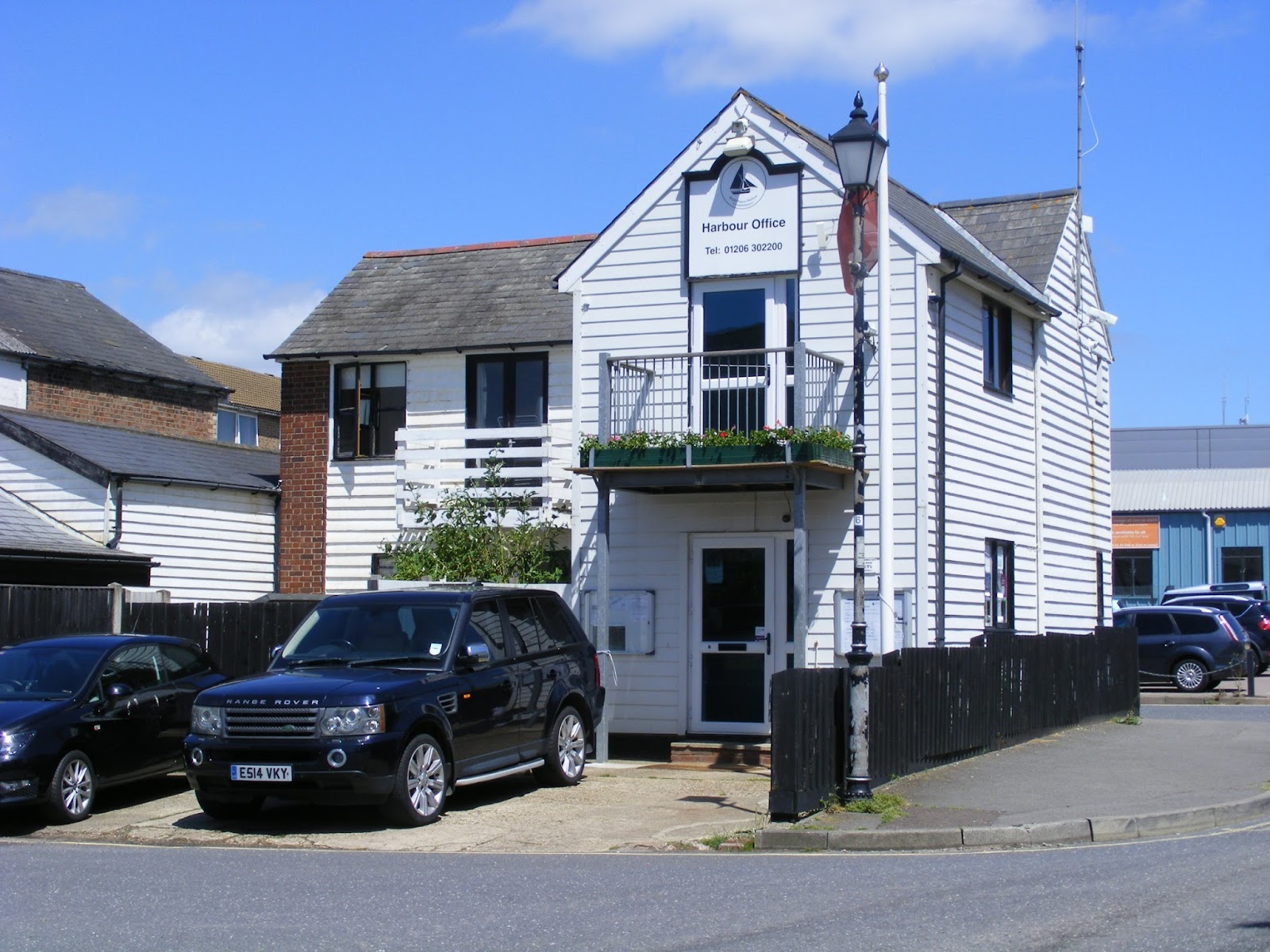 |
| Brightlingsea: Harbour office |
 |
| Brightlingsea: Departure of the ferry to Point Clear |
My day was completed by a visit to the East Anglian Railway Museum at Chappel and Wakes Colne station on the (still alive) branch line from Marks Tey to Sudbury. A private function was taking place on the premises, but this didn't prevent me briefly viewing the exhibits before making my way home. It was a great way to begin what promises to be a busy summer month, culminating in my holiday, of which more later.
This week has been very much taken up by diligently collecting all the details of the recent General Election. I'm not exactly sure what use I will make of this data in the coming months, but in the great scheme of things it seemed a worthwhile use of the time if I'm to make a positive contribution to the reform of our electoral system as mentioned here last week.
Apart from the computer screen, I've also been busy with preparations for two events at our church. Tomorrow sees our annual Fun Day, when we provide activities, crafts, snacks, drinks and a barbecue for the whole community, whether church people or not. Today was preparation day, when the interior of the church was transformed into a series of 'pods', where the various craft exercises can take place, and I was one of a small team who spent an active morning achieving this. Tomorrow promises to be busy from breakfast time when the climbing wall arrives to be erected by skilled engineers.
We've also been busy rehearsing musical items for both Fathers' Day on Sunday and a special service in a few weeks' time to mark the last day of our present vicars who are leaving to take up new roles elsewhere in the country. That will be a day of very mixed emotions, as we wish them well in this, but also come to terms with not having them with us after seven very happy years under their leadership.
Subscribe to:
Posts (Atom)