Friday, 16 June 2017

Sunny Days of Early Summer

Bourne Mill, originally
a 16th century country house
In the beautiful weather of last weekend, I think I can be excused for the decision to spend Saturday enjoying the open air.  I went first to Bourne Mill, a National Trust property in the Essex town of Colchester.

Its first appearance was as a country house of an Elizabethan country gentleman, built using materials from a nearby monastery that had been a victim of Henry VIII's dissolution.  It was later developed as water-powered fulling mill, where the local woollen cloth was processed.  In the eighteenth century it was extended and the mechanism re-developed for use as a corn mill.

I then went on to a seaside with a difference.  Far from the sand and paddling of the usual seaside resort (not to say that it has neither, of course), Brightlingsea is a place that I don't recall having been to before, but one that I recall from my childhood when a rather unusual toy was an out-of-date railway timetable.

The rail link to the town closed in 1964, and the site of the station long since redeveloped.  However, I parked outside the Railway public house, which is still operational, and took a walk around the nearby streets, eventually ending up at the 'Hard', where there were many pleasure craft to be seen.
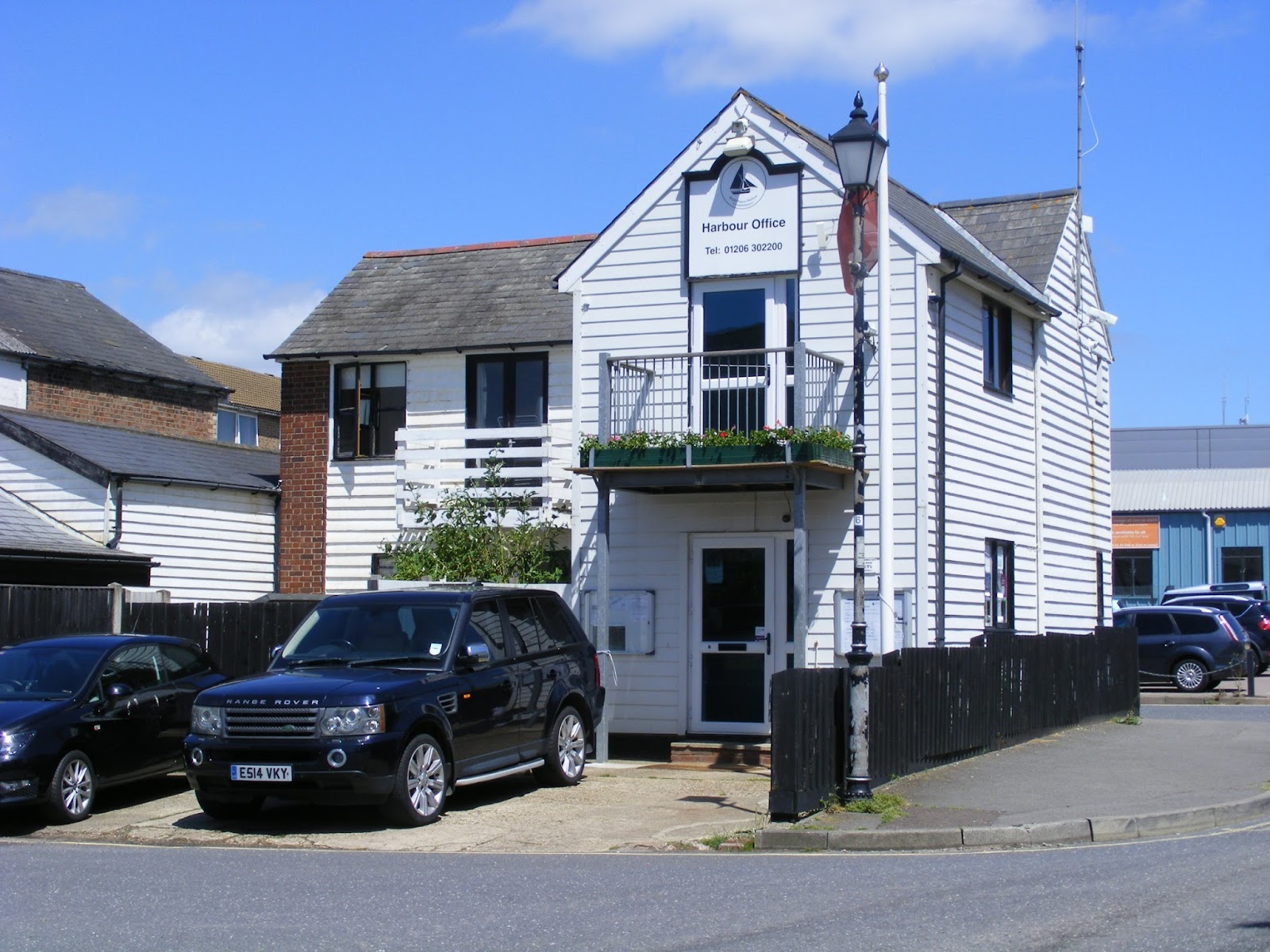
Brightlingsea: Harbour office
After a snack at a tea-shop opposite the harbour office, I wandered along the pier where a ferry leaves for nearby Point Clear or Mersea Island, to either of which the nearest route is via the many branches of the Colne estuary rather than a longer trip by road.
Brightlingsea: Departure of
the ferry to Point Clear

My day was completed by a visit to the East Anglian Railway Museum at Chappel and Wakes Colne station on the (still alive) branch line from Marks Tey to Sudbury.  A private function was taking place on the premises, but this didn't prevent me briefly viewing the exhibits before making my way home. It was a great way to begin what promises to be a busy summer month, culminating in my holiday, of which more later.

This week has been very much taken up by diligently collecting all the details of the recent General Election.  I'm not exactly sure what use I will make of this data in the coming months, but in the great scheme of things it seemed a worthwhile use of the time if I'm to make a positive contribution to the reform of our electoral system as mentioned here last week.

Apart from the computer screen, I've also been busy with preparations for two events at our church.  Tomorrow sees our annual Fun Day, when we provide activities, crafts, snacks, drinks and a barbecue for the whole community, whether church people or not.  Today was preparation day, when the interior of the church was transformed into a series of 'pods', where the various craft exercises can take place, and I was one of a small team who spent an active morning achieving this.  Tomorrow promises to be busy from breakfast time when the climbing wall arrives to be erected by skilled engineers.

We've also been busy rehearsing musical items for both Fathers' Day on Sunday and a special service in a few weeks' time to mark the last day of our present vicars who are leaving to take up new roles elsewhere in the country. That will be a day of very mixed emotions, as we wish them well in this, but also come to terms with not having them with us after seven very happy years under their leadership.

Friday, 9 June 2017

As the Dust Settles

I can't remember - or be bothered to research - how many Friday mornings I've woken up after a General Election to the thought that 'it's a new world out there today'.  As one person whose views I respect has written this morning, "all has changed, and yet nothing has changed ... it's business as usual."

Business as usual in the political world will still include such famous characters as Dennis Skinner, the 'Beast of Bolsover', and the neighbouring county has again returned Kenneth Clarke, both of whom I admire for speaking boldly what they feel ... and often causing amusement by so doing. From the same area, Anna Soubry will also be returning to the Commons; I felt that she summarised the resulting situation well: "what should have been certainty ... is now no overall control ... there is more confusion ... we are more divided."  It was a sentiment echoed by the defeated Nick Clegg, who referred to "a deeply divided and polarised nation" as he called for members of the new House to espouse co-operation, rather than continue to focus on what divides them.

The earliest General Election I can remember must have been in 1959.  I had persuaded my mother that I had to go to school as usual on polling day, but in reality I had gone off to play with my friends.  Unfortunately, my deceit was detected and I suffered the embarrassment of being dragged away from them and taken home to suffer whatever punishment that - blissfully - I can no longer recall.

The intervening occasions have passed with a varying degree of academic interest.  I have long been fascinated by numbers and how the fortunes of the various parties have interwoven down the years.  This year, for the first time, I've been personally involved and so my attention was more intense.  I was pleased to assist my local party at a modest level, but decided that I could be most useful at a nearby 'target seat' where, over a total of five days, I made new friends and learned quite a bit about the organisation that goes on behind the scenes at an election, while undertaking a variety of useful tasks.  Naturally I was disappointed that our candidate wasn't successful, but I'm sure she will live to fight another day.

At some point during these recent weeks, I was asked why I had joined the party in the first place.  After reflection, I realised that - quite distinct among the many policies it promotes and with which I agree - one thing above all others is of paramount importance to me.  I have never been represented in parliament by an MP whose views match my own.  I imagine this is the situation of many, many more across our land.  In 2007, I was in a position to follow the General Election in the Republic of Ireland by listening to RTÉ as I drove around the country.  I was intrigued by their electoral system and, as I followed this up by further research, I realised how much fairer it is than our own.

All of their representatives are directly elected by constituencies as are ours, but these are multi-member constituencies, electing three, four or five members each.  Votes for losing candidates and those for winning candidates that are in excess of the number required for election are re-distributed according to second or further preferences and the outcome is usually one in which at least one member from each of the major parties is returned by each constituency ... overcoming the frustration that has been my experience during all of my adult life.

It is now my convinced belief that such a system would go a long way to addressing that very divided state that we now find ourselves in, a state that has dogged our parliamentary history for decades ... in fact for all of the modern era since the Great Reform Act of 1832.

The measure of unfairness of our present system can be easily calculated. With one seat awaiting its third recount in the coming days, yesterday's election has given 92% of the seats to the two largest parties on the strength of 82% of the votes cast.  While these two figures could be said to be 'generally' fair, consider the effect on the remaining 5.6 million voters.  Over a million are not represented at all; of the rest, 35 seats in Scotland have used an average of less than 28000 votes each; the Liberal Democrats' 12 seats have cost almost 200,000 votes apiece and each of the remaining 23 seats (mostly in Northern Ireland) has required a more reasonable, though still excessive, 54,500 votes.

It has been reckoned that the 'wasted' votes in the 2015 General Election - those that either didn't elect anyone, or were in excess of those required to elect the chosen candidate - amounted to a staggering 71% of the total votes cast, down from 74% in 2010.

It's a matter that needs addressing - by minds and personalities far greater than mine - but to the benefit of the whole nation.

Saturday, 3 June 2017

Almost There Now ...

You know how it is when somebody important or famous dies, or when a great tragedy - such as the bombing in Manchester the other week - occurs? For a while there's little else in the news and all thought seems to be dominated by this one event.  It's the same at the moment with the General Election.  After all the build-up, I think everyone will breathe a sigh of relief when Thursday evening comes and it's all over.  Certainly that's the feeling among teams on the ground, whether engaged in canvassing, delivering leaflets, or the planning, printing, stuffing envelopes or sorting that goes on behind the scenes.

Yes, it will soon be over; but one important thing remains.  I hope my readers will not ignore their hard-won right to vote in the election.  If you aren't a staunch supporter of one party or another, perhaps the choice of who to vote for is still a difficult decision yet to be made.  One way is to draw up a list of the various claims of each party standing, decide which of their policies you agree with and which not, and simply vote for the party with the most likes.

Some may advise you to vote tactically: to vote for the party most likely to defeat the one with your most dislikes.  This might be effective under our present electoral system, but has always seemed to me to be disloyal to the values I hold dear.  When proportional representation comes - as, sooner or later, it must - there will be no need for tactical voting because, wherever your sympathies lie, a vote for your preferred choices will not be wasted.

One friend told me the other week that "so-and-so candidate is a sweetie, so he gets my vote, otherwise I would have voted for your party."   I don't particularly like my party's candidate, but I've voted for her because of the policies she espouses, not because of her personal appeal ... or lack of it. After all, it doesn't matter whether it's warm water or cold that you use to pressure-wash your yard, so long as the pressure is there to do the job.

I'm reminded of an incident that (fortunately?) occurred so many years ago that all of the people involved are now dead.  It happened while I was a teenager working in a grocer's shop during the school holidays.  A customer had been bewailing the fact that no suitable toilet rolls were available on the shelves.  There were blue rolls, green rolls, yellow and white rolls, but this lady was interested only in pink ones, of which there were none.  After a lengthy discussion on the matter, she left ... disappointed and empty-handed.  As the door closed behind her, one assistant turned to the other and remarked, "I don't know about you, but my bum doesn't mind what colour wipes it!"

Saturday, 27 May 2017

Word-play

It's an accepted fact (I think) that families develop a sort of language of their own.  Certain words or phrases take on meanings that are different from normal and peculiar to the family members.  Sometimes completely new words are introduced, often out of what a toddler has said when trying to emulate the adult sounds that surround its growing up.

The same is true of other groups than families, and the phenomenon also includes sayings that are particularly common, or over-used in the group, and - in my experience, at least - word games not found anywhere other than in that office.

A format that I sometimes use fits into this general spectrum.  I will say, "Words like ...... and ...... come to mind!", filling the gaps with two or three words from a familiar phrase, saying or proverb that is well-known, and leaving my listener to understand the full significance of my remark by recognising the whole expression from my clues.

An example of this bounced back at me this week, when someone asked me, "hoist and petard?".  I recognised the full expression, and had to agree that the occurrence I had just related was a consequence of my own comment some while previously.

A few months ago, I had agreed to deliver some political leaflets in the roads near my home.  Thinking that the untidiness of the way they had been folded detracted from the message they carried, I commented about this to the person who had brought them to me and offered, should another occasion arise, to fold them myself.

Weeks passed, and more leaflets needed to be delivered.  A boxful appeared and, after taking out sufficient for my requirements, I folded the rest to be collected a few days later, and then folded and delivered my own.  Last weekend found me briefly helping to man a street stall, after which I brought home a box of 2,000 leaflets, which I folded over the weekend.  When they were collected on Monday, another, smaller box replaced them on my floor, which are now folded and ready to move on next week.

It did sound as if I were bemoaning the loss of some of my free time this week but that was not the case. It was a simple task in what I hold to be a good cause, the execution of which was in some ways therapeutic.

I hope my readers will agree that it has provided a lighter alternative topic for this blog than the terrible events of Monday evening that have dominated the week's headlines.  While a matter for much thought, prayer and sympathy, there is a limit to what more can be written about them.

Saturday, 20 May 2017

Light Under the Shadows

Looking back from here, it's been a good week ... in some ways a very good week.  Isn't it strange, though, how one bad experience can cover everything else with shadow?

It all began last Saturday when, fairly late in the evening after a busy day, I was catching up with my e-mails.  I found one that I felt deserved a lengthy response for which I didn't have time; I whizzed off a brief note that said little and was capable of misinterpretation.  In the light of later explanations, I now realise, it would have been better if I hadn't replied at all, because my desire to respond in the first place had been based on a wrong understanding of the circumstances.

It all culminated in a semi-public reprimand by the recipient of my mail, who began with that ominous phrase, "I was hurt ...".  My apology and attempted explanation were somewhat dimmed by - and certainly not accepted amidst - the succeeding onslaught!  The positive side of the overall experience came later, when I compared my own reaction to what it might have been some years ago.  Instead of walking off in a huff - which would have aggravated the situation - or worse, I sat still and quiet until the anger had subsided; I repeated my apology and we parted civilly.  I spent much of the ensuing evening going over and over the whole episode, questioning my reasoning and justification, and then moved on.

The rest of the week has been busy.  Sunday afternoon saw the licensing of a friend as a Reader (lay minister) in the church and I was pleased to be able to be present in the cathedral for the service.  In fact, I sat with his family but, not wishing to invade their ensuing celebrations, returned home promptly afterwards.

I picked up my Welsh learning again the other day, realising that, once more, some weeks had passed since last touching it.  Last summer, I bought a few books i'r iaeth Gymreig that I thought might prove interesting.  I had begun to read the smallest one and, very slowly, with extensive help from the dictionary and reference to the lessons, have made headway through the first pages.  This time, to my great delight, I managed a whole paragraph in the best part of a morning!

Another thing that has revived is the involvement in Health & Safety matters.  After lots of activity last year, things have been quite quiet for some months but a call from the churchwarden (my boss for this purpose) re-activated me and set me a new challenge which was, I confess, an exciting diversion.

Talking of diversions, choral music is one of my favourites.  After the delights of Easter, its absence was noticeable but now we have two new pieces to get our teeth (or rather voices) into and I was pleasantly contented with the progress made by the few of us who were able to make the first of a recently organised series of practices.

And, with the weather being so up and down just now, I was very lucky to find Thursday morning bright and sunny (although there was rain later in the day) because I had signed up for an historic walk on the outskirts of Barnet.  The start was at a modern shopping centre, built on the site of a former Methodist church, and we met by the church's foundation stone still embedded in the wall on the High Street.  After a couple of hours' stroll looking at a sequence of mostly Georgian houses, and the pleasant parkland that has replace a former manor house, we finished on the edge of a common that was once part of Enfield Chase, a medieval royal deer park that, when it was dispersed by Act of Parliament in 1777, covered nearly 8,500 acres.

The final - perhaps crowning - feature of the week was an e-mail link received this morning to a hitherto unknown second cousin, who learned of me through a website featuring a picture of our great-grandfather's grave.

Who knows what next week will bring?

Friday, 12 May 2017

Sequel - the Budkeeper's family story

In my first post of this year - as an adjunct to the reasoning behind a new year's resolution to think of other people - I told of a nine-year-old I'd discovered in the 1851 census whose occupation was given as 'Ag Budkeeper'.  You can read the story of him and his family, so far as I knew it then,  here.  As part of the ongoing mopping-up operation following the hasty, corner-cutting completion of the twin family trees I presented to my cousin and her husband for their golden wedding in March, I have now been able to piece together a bit more of their story.

In 1851, this boy was one of a family headed by his father, who was shown as 'married' but, instead of his wife, the senior female was an 18-year-old daughter.  The story began, therefore, as I looked for the matriarch.  I quickly located her in the next village, attending her eldest daughter, who a week earlier had given birth to what appeared to be her fourth child.  This babe was named on the census as 'Susana' which, with only one 'n', looked rather strange.  I later located her ten years later, and also found her birth registration ... as Honor, not Susan or Susanna.  The dates match and preclude the birth of another child, so this evidence leads me to conclude that what the enumerator - or more likely a neighbour who filled in the household form - had heard and written in 1851 as 'Susana' was actually 'She's Honor'.

Honor had been born into a household comprising her mother, Mary Ann, a one-year-old sister, Emma, her uncle James, a 14-year-old chimney sweep, and her grandmother, Ann, 62, whose absence from her marital home had prompted my investigation in the first place.  Back in this family home with the baby's grandfather, George, were two aunts, Martha, 18, and Susan, 16, another uncle, the 9-year-old John - the 'Budkeeper' of my earlier post - and two more people, Sarah, 7, and George, 5, who were described as 'granddaughter' and 'grandson'.  These two later proved to be Honor's sister and brother, whom I presumed had been moved out of the cottage to give room for the birth to take place in as much comfort and dignity as conditions would allow.

Mary Ann was married early in 1852 to James Jarman and as it appears in 1861 their family seems 'established'.  James had been in Norwich Castle Prison in 1851, but now, happily married, he was working as a chimney sweep and Mary - unusually, since most wives were not normally accorded an occupation - was described as a 'herb gatherer', so it seems likely that she may have had a reputation as a woman who knew about herbs and their properties, knowledge perhaps acquired in days when she had had to fend for herself.  George, now a 15-year-old chimney sweep, and Emma now 11, still retained their mother's maiden name, but Honor was now known as Jarman, and had been joined by four further children, soon to be followed by a fifth early in 1862.

The 1861 census shows that Sarah had stayed with her grandparents, where, now aged 18, she was described as 'daughter', notwithstanding that her 'mother' Ann was 72.  This thought led me also to question whose child John had been, for, although there was no sign of him after his famous appearance in 1851 as a 'budkeeper', his birth was registered in 1842.  Since the indication is that Ann had been born in 1788 or '89, her even being his mother is suspect.

Mary Ann died in 1880 and James in 1892.  Their apparent happiness of the early '60s wasn't to last, however, for Honor and two of her young siblings died within days of each other in November 1863, presumably of some winter illness.  Although I have yet to examine a copy of the burial register, I find it sad that, from the very reliable transcript produced by the family history society, while burials are recorded for both parents in due course, and for the two younger children, there is no burial record for Honor, under either Jarman or her birth name.  Was there still some stigma about her being born before her parents married?  We may never know.

As always, in family histories, there are so many questions left unanswered. What happened to John? Was James his father - or George's or Emma's? Why was James in prison?  When James died in 1892, he had been living with a grandson, also called John; did he marry and have a 20th-century family?  What is interesting is how the people we do know about appear to have conducted their lives, and what stories - even conversations - we can imagine from the facts we have unearthed.

Friday, 5 May 2017

Too Little? Too Late!

My Bank Holiday excursion was to an event entitled 'Middy at War'.  An intriguing title, you might think, until you realise that the war was World War II, and 'Middy' is the affectionate name given to the Mid-Suffolk Light Railway.  The event combined a WWII commemoration, giving local enthusiasts the opportunity to dress up and show off their preserved artefacts, with a chance to enjoy the wonderful achievements over 25 years of a band of steam railway aficionados who have re-created - almost from nothing: see the picture below - the image of a railway that had been extinct for 40 years.
Sandbags and steam: 'Middy at War'

The result was an unexpectedly enjoyable time sampling the perhaps inappropriate juxtaposition of twin themes that, separately, intrigue and delight me ... and for once, the weather didn't spoil things, either!

The Mid-Suffolk Light Railway was late on the scene compared to the heyday of railway building in the Victorian era.  It wasn't until the passing of the Light Railways Act in 1896 that the scheme was even considered possible.  The original intention was to link a number of villages in the agricultural Suffolk heartland to the nationwide railway network that had developed by the end of the nineteenth century.  The main route would be from Haughley to Halesworth, with a branch from Kenton to join the east Suffolk line just north of Ipswich, and a further link from Debenham joining the main line to Norwich at Needham Market.  This latter arm had already been discarded as being too adventurous before the company was formed in 1901.

There were disputes with contractors, and financial problems but eventually a goods service was opened between Haughley and Laxfield in 1904.  The marshy terrain west of Halesworth posed further difficulties, and only a further 2 miles or so of track was laid as far as Cratfield by the time the general shortage of funds, together with the bankruptcy of the chairman, led to a receiver being called in during 1907.  The original intention had been to delay passenger services until the whole system had been constructed.  Now, however, it was decided to utilise what had been achieved, and a passenger service between Haughley and Laxfield commenced in September 1908.

Mendlesham station c.1909; the building
forms the heart of MSLR today
A basic pattern of about three trains each way per day was established.  The main business was provided by the local farms, taking away cattle, sheep, barley, potatoes and other crops, and bringing farm supplies, machinery, seed potatoes, etc. Passenger traffic mainly comprised children going to school and farmers to market, but featured the occasional excursion from these rural villages to the seaside at Felixstowe or Clacton, which was all some families could afford as an annual treat.

The last arrival at Laxfield, 1952
With an annual turnover about the time of the First World War of little over £5,000 and costs amounting to over 90% of that, compared to an overall investment that exceeded £200,000, it can be seen that there was little future for the line.  It became part of the LNER in 1924, but faced a steady decline as the speed limit of 25 mph, and lengthy shunting delays added to the threat of road competition.  Brief respite was afforded during WWII as a result of a nearby aerodrome, but the line was closed in July 1952.

Horham station, c.1982
In 1990, a group of enthusiasts formed the Mid-Suffolk Light Railway Society.  They were able to lease the former good yard at Brockford and, starting with the bush-covered hump that had once been the cattle loading bank, the only relic of Brockford station, they began collecting the remaining derelict buildings and equipment from all the other stations along the line.  Gradually, as opportunity, finance and labour has become available, they have added this and restored that and the result is a working tourist attraction that is now on the brink of further expansion along the old track-bed.  They also have hopes of one day restoring their own locomotive.

Steam comes to the MSLR again