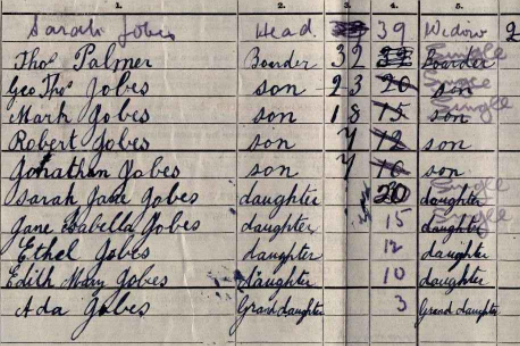
The family also boasted a granddaughter, Ada, born in the June quarter of 1907 and correctly entered as 3 years old. As can be seen here, the sons were listed first after Sarah and Thomas, and then all the daughters. It would appear that Sarah's thoughts as she entered the name of her eldest daughter were on her granddaughter, because the age 20 for Sarah Jane was superimposed on the 3 for Ada, suggesting, perhaps, that Sarah Jane rather than her absent sister Mary Hannah, by then aged 19, was Ada's mother.
Saturday, 18 February 2023
The 1921 Shortcut Misfired ... and how!
The family also boasted a granddaughter, Ada, born in the June quarter of 1907 and correctly entered as 3 years old. As can be seen here, the sons were listed first after Sarah and Thomas, and then all the daughters. It would appear that Sarah's thoughts as she entered the name of her eldest daughter were on her granddaughter, because the age 20 for Sarah Jane was superimposed on the 3 for Ada, suggesting, perhaps, that Sarah Jane rather than her absent sister Mary Hannah, by then aged 19, was Ada's mother.
Saturday, 11 February 2023
Were These the Consequences of a Hard Bargain?
I suspect there are many researchers who have adopted the same, almost 'casual' attitude to their family history digging as mine. I find that the son or daughter of a family has married, I track down their children and follow them through census after census, and so on, working forwards and outwards. Then finally - almost as an afterthought - I'll work backwards from those spouses, tracing each of them back to birth. If anything catches my interest along the way then I'll broaden the present track before again following that general pattern.
Last April and June, I posted in two parts the story of a family tragedy that began as a newspaper obituary following a dual death in a Suffolk village. You can read about it here (part one) and here (part two). In the autumn, I combined those two posts into an article for the local family history magazine. Eventually the trail circled round and I received an e-mail that drew my attention back to that tragic family. As a result, earlier this week, I found myself working backwards along the life records of someone who was a daughter-in-law of the couple who died.
Working forwards, I had come to a stop at the 1939 Register, which added a date of birth to the ages on the intermediate censuses. Married in 1895, she was born in 1875 so, typically, there were only two earlier census entries to find between the couple's marriage and this woman's birth. And there she was, Anna Barker, in service at the age of 15 in 1891, one down, one to go. Anna Barker aged 5 in 1881 proved impossible, however. I found one, but her place of birth didn't match, and the appropriate birth registration - there was one - didn't match with the date on the 1939 Register. Usually if there's a discrepancy there, it's the correct birthday and the wrong year, for one reason or another. And anyway I'd already found a birth registration for the Anna I was looking for ... and that one matched both for place of birth, Occold, and a September registration for a 10th June birth, which wasn't out of the ordinary: Anna Barker, mother's maiden name Davey.
After I'd found James and Anna's first three children, and the registrations of their birth, I'd noted a peculiarity, and this note was brought to mind now, as I puzzled why a 5-year-old girl should be missing from the census. Her first two children (and, I later discovered, her fifth, too) had been registered with mother's maiden name - so often the key to an identity puzzle - 'Lambert'. Why so, when her name was Barker.
Just on the off-chance, I tried looking for an Anna Lambert, born 1875. Bingo, there she was with her family in Occold as one might expect, along with five brothers, three born in Occold like her and the eldest two in neighbouring Wickham Skeith like their mother. The father of the family was the key identifier: he was born in Aylsham, Norfolk. Like a hound on a strong scent, I followed this family back to source. The names of the children came and went but there were enough overlaps, together with parents Thomas born Aylsham and Eliza born Wickham Skeith, to be sure I had the right family. As I worked back through 1871, 1861 and 1851 I realised I had the answer about those children being registered Lambert instead of the expected Barker Sometimes they appeared as one, sometimes the other. In 1851, I believe I might have the explanation. At least my imagination has concocted a story that might or might not fit the evidence I had unearthed.
The 1851 census recorded the whole family, living 'by the Knowl' in Wickham Skeith. William Davey, his wife Susan, aged 50 and 51, four sons, aged 15, 12, 10 and 3, a daughter aged 5 and added at the end was Thomas Lambert, 21, son-in-law, Eliza, 19, daughter and Jacob, 1 month old, grandson. There were two interesting points there. The only one of those with an occupation was Thomas, an agricultural labourer. Ordinarily, one might suppose that William and at least two of the sons would also be working. No one was indicated to be unable to work, and none of the younger ones was listed as 'scholar'. Then I looked into the Lambert trio.
I found a marriage for Thomas Barker and Eliza Davey in the March quarter of 1851, and in the same quarter a birth record is Jacob Barker, with mother's maiden name Davy. The family appeared with the name Barker in the census of 1861, as Lambert in 1871 and 1881, and then again as Barker in 1891. They had up to 17 children altogether, for 15 of whom I found birth records ... all as Barker and all with variations of Davey as mother's maiden name. No registration was found for the other two, but the birth years are close enough for the names to become confused across the various censuses.
So, why the dual identity? This is my theory. William Davey was not a violent man, but he was a man of great internal strength. When he discovered that this man Lambert had, to use the comedian's euphemism, 'been a bit previous with his daughter', he was livid, but realistic. He made a hard bargain with Lambert and attached a severe penalty to it. Lambert would marry Eliza (which he did, about the same time as she gave birth to his son), so his grandson would not carry the stigma of being illegitimate. William Davey would provide him with a home, but in return Lambert would be expected to work hard enough to keep the family. Naturally, Thomas Lambert didn't like this arrangement, but he didn't like whatever penalty went with default. So he devised an alternative identity. Why else was he married as Barker, and all his children registered as Barker? He and Eliza left her dominant father, and made their own way in the world, occasionally lapsing to the old name when the censuses came around.
Little wonder, then, that almost half a century later, When Anna's first children needed to be registered, that she should be confused and uncertain which guise to adopt.
Saturday, 28 January 2023
On a Seaside Holiday in 1921 ...
We were warned that a summer census would make some people more difficult to find. I found the man I was looking for quite easily, but also stumbled on the unexpected aftermath of another story besides.
I had been working for much of last year on the family of my cousin's husband's grandmother, who was one of 18 children. Her younger brother was married in the September quarter of 1917, and when I found him and his wife by 'trial and error' in Great Yarmouth in the 1921 Census, I decided that they had quite likely taken a summer holiday. He was a farmer, so a June holiday would be quite likely - a fact that I knew from personal experience. My father was a farm worker and holidays in my school holidays were always ruled out because of the harvest.
I had decided that, when my Findmypast subscription was due for renewal after Christmas, I would upgrade it to included unlimited access to the 1921 Census and, at odd moments recently, I've been looking up the people I thought I'd found already, to get a proper reference make sure I had found the right person and glean whatever else I could from the entry. In this case, I certainly got more than I'd bargained for!
I found the couple I was looking for - yes, Stephen and Daisy Kerridge (lines 4 & 5) were the farmer and his wife. I was a bit puzzled that all five immediately visible occupants were visitors, but then I clicked on the 'show more' button and revealed the host family. Why put themselves last? a gesture of importance to their guests, perhaps, who knows? Even as I revealed this bricklayer and his family, my mind was registering the name of the first person on the list: Sarah Boggis.
Notwithstanding that a girl named Sarah who was at school at the same time as me later became a Mrs Boggis, it wasn't until I looked further down the list and found Archibald J Francis that I realised that Sarah Boggis was the ultimate married name of my great-great-aunt. So here was an intermediate snapshot in a story that began way back in the 19th century.
Archie Francis was, sadly, a figure of fun in the family as I grew up. In those days little boys didn't question what their elders shared 'over their heads'; we either learned by listening quietly or, as in this case, only as a result of unearthing the family history as a retired adult.
His father, James Francis was born in March 1835 and, at the age of 21, married my 3 x great-aunt, Mary Ann Sturgeon. By 1871 he was an 'engine driver', and ten years later was more clearly described as a 'threshing engine proprietor', which remained his occupation for the rest of his life. In 1902, after almost 46 years of childless marriage, Mary Ann died. Two years or so later, James married his niece, Sarah, who promptly presented him with a son ... Archie. I think my mother and her family were mildly amused by the fact that this distant relative had suddenly become a father at the age of 70 ... or maybe it tickled them that, at the age of 25, Archie went on to marry his cousin (the daughter of Sarah's elder sister), who was some four-and-a-half years his senior!
James died in 1916 and, still only in her early 40s, Sarah was married the following year to John Boggis. (I think it was a descendant of John's brother who married the Sarah I mentioned above.) My grandfather's aunt Sarah had clearly held on to the business that her late husband had built up over the decades, hence her rather unusual occupation on the census form, 'threshing engine proprietress'. The same logic would prevail regarding the choice of June for a holiday, and why not take her unemployed son with her? The business could clearly look after itself for a week.
As indeed it did; in 1939, Archie was recorded as a threshing contractor and, two households further on, was John Boggis, a threshing engine owner. Whether one owned what the other used is anyone's guess, but it's likely they were in business together.
Saturday, 26 November 2022
Crocodile and Blue Wave Experience
Saturday, 5 November 2022
Thass loike I saay ... teark loife as 't come
Some things happen one day and are gone from memory the next. Others stay for decades, as bright and fresh (or so I believe!) as the day they happened. One that came to mind the other day dates back to my first year of married life, and a dining-room incident while on holiday; another that I recalled the same day stems from my pre-school days, when my mother took me into the shop where, not five years previously, she would have been working in the days before her marriage. A third recollection comes to mind even as I ponder narrating two incidents of the week just past.
I'm something of a natural mimic. When I was driving for a living, I had to be careful when delivering in another part of the country, not to lapse into the local accent. Quite apart from the likelihood of 'not getting it quite right', there was always the possibility that someone would be offended if they thought I was taking the mickey at the way they talked. One day I'd been given a job to the Newcastle area and by the time I'd gone the five miles to collect it, I was already muttering to myself 'in Geordie'!
I can't help wondering whether this ability bears some relationship to my delight in languages. In my days at the local grammar school, I recall getting 98% for French in my first form examination. In these days of possibly greater wisdom, I find myself being more careful about accents, and I only lapse into the broad tones of my youth on the Norfolk-Suffolk border when I'm among people with whom I'm completely at ease.
Two incidents this week have brought these things to mind. On Sunday morning after the coffee and chatter that followed our Meeting for Worship, I said something to one of the elders as I was leaving in just that broad accent that I've described ... and realised what an indication that was of how 'at home' I feel in their company.
For the last few months I've been going most Thursdays to a community coffee morning in the town. This week, instead of a simple quiz to tax our minds, we were asked to help wrap children's presents for Santa Claus to distribute when he comes along next month. I had been cutting paper off a large roll to fit the books that others were wrapping. When the last of the paper sprang free from the tube within, I turned to the lady sitting next to me and, without thinking, imitated the accent I've been surrounded by for the last year and more as I commented. "Ah've coom to t'end o' t'roll; Ah'm goin' 'oom."
That was an example of the other aspect of my experiences. I clearly had no fears about offending her ... although, in point of fact, she's only been here a few years herself, after moving up from Bristol, so it wasn't her accent I was imitating. Instead, she was quite amused and possibly a bit surprised, since I'm usually quite quiet and restrained.
It all goes to show how well I've settled into a new pattern of life. One aspect of this new shape to things is retiring to the lounge in the evening, and so I'm no longer tempted to carry on working at my desk until bedtime, as would often have been the case before I moved out of the flat. Instead, I use my old laptop to watch a selection of You-Tube videos. Two in particular, I find extremely relaxing.
One is The Mindful Narrowboat, presented by a lady cruising the canal system with her dog. She has an eye for nature and is also quite artistic, for each vlog ends with an 'over-the-shoulder' shot of her entry in a beautiful notebook, in which a poetic summary of the foregoing scenes accompanies coloured sketches of birds, animals or plants that she has noticed along the way. It's rather in the style of 'The Diary of an Edwardian Lady'.
The second video is called Linguoer Mechanic, this one featuring a young oriental lady. The posts follow a common pattern, with no narrative at all. She collects a rusty or corroded piece of machinery, dismantles it and cleans each part, before painting and rebuilding the whole, and finally demonstrating it working once more as it did when new. I'm amazed how she knows what bit goes where!
Saturday, 29 October 2022
I Want Apple Crumble!
I make no bones about it, and readily confess that apple crumble is by far my favourite dessert dish. As a virtually self-taught and very limited cook, it's one that I can manage quite well, with the help of a proprietary brand of crumble mix, an ever-present item in my store cupboard.
Switch on your imagination for a moment, dear reader. Imagine that, instead of blazing this desire abroad in a blog, I had announced my wishes to a loving and supportive wife. Imagine further that her response was "But we haven't any apples, darling." Imagine even further my rejoinder: "That's all right, dear, we've got lots of eggs." Depending on factors outwith this hypothetical narrative, the outcome would be anything within the range from sympathetic laughter, to "don't be silly!", to grounds for divorce.
This weekend the second-class citizens of this country, who happen to live in Northern Ireland, have been told that they will soon be filing into the polling stations to elect a new Assembly. Why? Basically it's because the existing Assembly has been unable to appoint a Speaker and therefore is unable to operate the democratic institution to which its members have been elected.
The Northern Ireland Secretary in Westminster has looked in the store cupboard of legislation, found the shelf where there are instructions for what to do when an Assembly has been unable to govern and - apparently without looking any further - has said 'Ah yes, well you've had six months to try, you'll have to have another election.' Solution provided, problem solved, next business please.
Only it isn't ... and it won't be.
The reason the present Assembly has been unable to operate is not that it couldn't come to a decision, but that one party has stubbornly - but possibly with good cause - refused to take part in any discussion towards that decision. There's little indication that the outcome of a new election will be very different from the present Assembly, and when it's all done and dusted, the new Assembly will face the same problem as the old. Does the population have to wait another six months with no one to take important and increasingly urgent decisions in the government of the country ... only to face another unproductive - and very expensive - election?
The underlying problem, as Sir Geoffrey Donaldson (DUP leader) succinctly stated on BBC R4's Today programme yesterday, is that, so long as the present arrangements for trade between Northern Ireland and the rest of the UK result in a tariff being charged on goods crossing the Irish Sea, the people of Northern Ireland will remain at a financial disadvantage compared to their fellows in Great Britain or, as he put it, 'be second-class citizens' of a supposedly United Kingdom. Whether or not he and his party are right to hold his countrymen hostage in this way and deprive them of normal government for months on end is, to some extent, a separate question.
The Secretary of State has to remove his blinkers and realise that eggs won't make an apple crumble. If he - or his colleagues in the Westminster government - don't address the fundamental difficulty (no apples), no progress will be made, however many eggs (or elections) he provides, in the production of apple crumble (stable and effective government).
I wrote here recently about the basic impossibility of squaring the circle of Northern Ireland, Brexit and the resulting need for a border somewhere. I don't propose to repeat that here. What I will say is that to me - and I expect to thousands of others - the solution is blindingly obvious, and one that would resolve other difficulties at the same time. The UK must seek to re-join the Single Market and Customs Union, the severance from which, as part of Brexit, caused the need for a border in the first place.
Saturday, 22 October 2022
The Elephant in the Room!
Well, it's happened. Many have been foreseeing it for some while. This patchwork quilt has come apart at the seams - I can't with any realism add 'at last' - and it is seen for what it was ... a pretence, a sham, something thrown together to give someone the transitory pleasure of holding the top job, a job for which she was never fit. Now she has resigned and we are subjected yet again to see the members of a once respectable political party thrashing around like rats in a sack as they try to find yet another leader who will, incidentally, be saddled with the responsibility of running the government of the country.
What's behind it all? Some would say it's a combination of world events: the Covid-19 pandemic; the war in Ukraine and its resulting effect on energy prices; a global decline in economic growth. Some go further, and are persuaded to admit a degree of incompetence in leadership. A few risk being labelled as 'Remoaners' or 'Remainers', as they suggest that the effects of these international matters have been made worse for this country by the self-inflicted difficulties and isolation resulting from Brexit. Although that was some years ago now, these effects have become visible at last in the form of increased (and apparently unforeseen) levels of bureaucracy and paperwork that have frustrated - and in many cases totally annihilated - international trade and have, at the same time, generated political frustration in Northern Ireland that is yet to be resolved.
Is that all? No. The roots of the present fiasco stretch back much further than that. If you have 6 minutes to spare, listen to this interview with trade union leader Mick Lynch. He specifically refers to situations created decades ago in many industries, not just his own.
Many background aspects of British life were distorted and made more difficult to operate by the introduction of a raft of private companies to manage them. Naturally, private companies have shareholders, and shareholders expect dividends. And where do these dividends come from? In part, I expect, from the efficiencies that were introduced by commercial managers as they competed with each other for business. But in far greater measure, I suggest, they come from increased prices to those using the services, whether it be transport, energy or clean water and sewerage facilities. And of course there's another component to commercial management - bonuses: bonuses that can be fairly easily won, and are, in effect, a virtually guaranteed addition to an already generous salary. These, too, have to be met by either increased productivity or turnover (which is another term for increased prices, when the consumption of those services is relatively stable).
But what is really behind all this trauma?
My Bible readings this week have been in the book of Jeremiah. There are many parallels with the present political situation. The nation is under threat. An invading army is just beyond the borders and people's leaders are turning in fear to their spiritual mentors for help. They are told in no uncertain terms that this is a peril they have brought upon themselves. They have not fulfilled the responsibilities of leadership. This is what they should be doing: "Administer justice every morning; rescue from the hand of the oppressor the one who has been robbed." (Jer. 21:12); "Do no wrong or violence to the foreigner, the fatherless or the widow, and do not shed innocent blood in this place." (Jer. 22:3)
You can read these two chapters in full here. They illustrate the penalties of selfish rule and oppression in many guises. These penalties can be readily understood in terms familiar to us, living two millennia and more later. The underlying truths are still valid today. Both as a nation and in the way our governments have led us down the decades, although efforts have been made to improve the lives of individuals, we have moved away from the basics of how man should treat his fellow man. Instead of being the servant of the people, the state has become their oppressor. Instead of welcoming the foreigner in need - as was the case eighty-odd years ago - we have shut our doors, closed our boundaries and barricaded ourselves with punitive legislation - poorly administered - against any acts of international human generosity.
I fear we will all pay the price for the neglect exercised by those we elect.
Saturday, 15 October 2022
A Flick Through the Diary
It's been an interesting couple of weeks. Quite apart from my car journey last weekend and its unexpected ending (see last week's post here), lots of other 'stuff' has happened. There have been acute aspects of long-term matters, expected developments and surprises. Such a mix deserves more than just a place on the diary page!
Let's start in the kitchen. For many years, it's been my habit to split a loaf of bread into three and store it thus in the freezer, removing one third of a loaf at a time for use. The reason for this is simply to prevent the end of a loaf from going mouldy before I get around to using it. For this process I use old bread bags to pack two portions of each new loaf into and, in order not to introduce any contamination - and thereby undermine my aims from the outset - I sterilise them first by popping them in the microwave for half a minute.
This week, I followed my usual habit, but the microwave objected, expressing its feelings with a flash, a bang and a puff of smoke. After packing the bread away in the freezer in un-sterilised bags, I ventured gingerly to test the microwave with a mug of water. To my surprise and great relief, the water got warm and I've used the machine quite normally ever since without further mechanical protest.
Before we leave the 'engine room', I have to admit a superlative degree of procrastination when it comes to maintenance arrangements. Over the last few months the hot tap has begun to drip. It moves easily enough to the off position but, it still allows water to drip out unless I apply pressure at the 'head' of the tap. Once I release that pressure the drips recommence. One night, out of curiosity, I measured how much was being wasted and found that almost a litre had accumulated from bedtime to breakfast. Inspired by recent videos of the discoveries as the level of water in the nearby reservoirs has got lower and lower, and realising that my drips are contributing to this decline, I finally called the agent yesterday to arrange for a plumber to visit.
Last week the postman delivered a large cheque from a finance company. It looked real so, in great excitement, I paid it into my account. On looking closely at the covering letter, however, I became suspicious that this could be a scam. There were many factors, but one in particular was the sentence about 'if you have difficulties in banking this cheque', which invited me to 'provide your bank details to us on the above number and we will cancel the cheque and pay the funds into your bank account.' I decided to leave the money in my account for a few days to see whether it would be clawed back once the banking system discovered it wasn't real. Meanwhile I wrote to the company expressing my misgivings.
Deciding this week that sufficient time had passed, and that reclamation would have happened if it were going to, I distributed the cash: some to charities, some to savings and some left for current use. Within hours of my doing this, I had a phone call from the finance company explaining that the cheque was genuine. After expressing my relief, I asked for more explanation. It transpires that one of my pension policies had a 'guaranteed minimum pension' clause and, at the time my Financial Advisor had arranged the transfer of this policy as part of tidying up my occupational pensions, its value didn't meet that guarantee provision. What I have now received is compensation for this oversight ... some nine years after the event!
The flow of my editing work for WEBBS has dried up for the moment. On one hand this has allowed me to focus on other things, such as family history, but it also leads me to feel unfulfilled as regards my contribution to the charity's work. My supervisor is taking advantage of this lull to offer help to another team who are coping with an urgent request and, as a result, some of this week has been spent 'back in the typing pool', keyboarding scriptures in the Balochi language.
And - last for this post - I can report that my development work as church treasurer has reached a 'plateau'. I've finally agreed my 'DIY ledger' on Excel to the embryonic system I've been setting up on QuickBooks and, when three bank statements arrived this week, I was able to enter them with some confidence into both systems.
What excitements will the next weeks hold, I wonder?
Saturday, 8 October 2022
Wrong Turnings
Many a good novel or play of the past has carried a subtitle: I offer but two examples, which you may or may not recognise: "or What You Will" and "or The Mistakes of a Night". This may not be in the same league, but today I offer one of my own to apply to what I'm about to write: "or Oh, I Know Where I Am Now".
When I started driving for a living, the number of times I'd driven within the M25 could be counted on one hand ... two at the most. I've often told of praying for a red traffic light so that I could snatch a quick peek at the map on the seat beside me. Eventually I learned my way around the metropolis, and my subtitle above was often muttered after following the map from one new destination to another.
Since moving to Yorkshire last summer, I've had to undergo just such a customisation. At first it was finding a shorter way to join the M1 southbound to avoid a lengthy dog-leg via the A1(M) and the M18. The first route I took was to junction 35 by way of Swinton, Rawmarsh and the outskirts of Rotherham. Then I found a shorter way through Mexborough and Conisbrough to junction 1 of the M18 and, more recently I've discovered an even shorter route to emerge at junction 31.
In each case, having noted my chosen route from the map (SatNav was no use because, as soon as I turned away from its suggestion, it was trying to turn me back again), I found I had to make the journey quite a number of times before I got it right, and I've lost count of the number of times I've told my cousin that I 'took a wrong turning at so-and-so'. The worst of it was, having checked with the map and realised where I went wrong, I then got that bit right next time, but made a different error instead.
During the Covid pandemic, having enjoyed many of their zoom lectures, I decided to join the Western Front Association, and last month I attended my first live meeting of the Yorkshire branch. The route was quite straightforward: A1(M), A64 and the York ring road. The only trouble was that virtually every time I'd driven up that part of the A1 I'd been going further, and by the time I spotted the A64 turning, I was in the wrong lane, still heading for Scotland! I only just got to the meeting in time!
Today I went to the next meeting. It was very good, and the speaker excellent. I made sure I was in the right lane at the right time and the journey was hitch-free. The bug was still with me, however. and I muffed getting on to the little side road to get me onto the village roads between the A1(M) and home. Instead of heading for my own front door, I was on the main road again, heading back towards Leeds!
Needless to say, I took the first possible escape route. I battled with totally unknown winding lanes and the blinding low-angled sun in my face, and at last I uttered that well worn subtitle again. I'd arrived in Hooton Pagnell, a beautiful village of stone buildings that I pass through if I go to watch Frickley Athletic play football.
Saturday, 1 October 2022
Going One Better!
There's always a temptation to build on a successful project. You want to achieve greater success; squeeze something else from a basic idea that went well ... build your own example, I'm sure you'll be able to agree with this maxim.
A few months ago I wrote about two cousins; when I attempted to eliminate one of them, I found that the data I'd collected applied to him and I had to find evidence to eliminate the other. This week I've attacked a similar challenge.
I've mentioned before my latest project, an attempt to provide mini-biographies of each of eighteen siblings and their respective families. A few weeks ago I decided I'd got as far as I could with research and that it was time to begin the write-up. I suppose it's inevitable that, over and over, I got to a certain point where some detail that seemed essential to the story was missing, and a quick flip back into research mode was essential.
So it was, this week, that I realised that I hadn't a note of the death of the husband of one of these siblings. Since he was born in the 1870s, I couldn't even hint that, 'at the time of writing, he's probably still alive'. It transpired that I had found a death, but hadn't recorded it because there was nothing to link this particular man, who died in 1964, with his putative wife. It was too early for his date of birth to be recorded in the death register, and it was in a part of the country that had no links with the family.
I checked back at the births, and found not one but three births of that name in the same county in the same year. Well, if I'm honest, it was one and two halves, rather than three. I was looking for William, and what I found was William, John William, and Willie. I compared these to the list of deaths who were born in the target year, 1879, or two years either side. It's a fairly rare surname, so there were only twelve of them - I realised that all three were represented. The twelve comprised two straight Williams (both in un-associated parts of the country, coupled with their birth years being either side of 1879); two William E's, one of which was the one I'd noted: the additional initial was another reason to be doubtful of him; a William H and two William Henrys; the afore-mentioned Willie and four 'also-rans', Charles, George, John and Robert, all of whom had a second initial: W.
The only clue I had to work with was the date of birth as recorded in the 1939 Register: 30th April 1879. Past experience has led me to assume that if this is incorrect, it's usually the year that is wrong, not the 'birthday'; thus I felt confident in eliminating Willie from the birth trio, because his birth was registered in the September quarter. April, I decided, was a bit too early to 'drift' into the following quarter.
I was left, then, with John William and William, both born in the June quarter. Of those deaths, John W was the only one of the twelve who had died 'in-county' and of the two William E's, the one I'd chosen was born 1879, the other was both further away and born in 1881. I decided that the only way to resolve this was to work forward from their births. They were fairly easy to find in their first two censuses and, in each case, I found registration entries for their parents' marriage to confirm I'd got the right family by checking with their mother's maiden name in the GRO birth index. My uncertainty was justified when I realised that apart from 1881, John William had been known as William.
By 1911, both had married; one had a son, the other a daughter. The William I sought married the subject of my project in 1934, so my next search was for the death of one of those wives. Fortunately they had different names. One was Ellen Mary, the other Elizabeth. There were many deaths for Elizabeth between 1911 and 1934, but the ages were all wrong; there was only one Ellen, in 1916, and her age matched the age of William's wife in 1911. And as a final bit of circumstantial evidence, when they were married in 1906, William had gratuitously added a second name Earnest to match Ellen's second name. Though not used in 1939, it matched the death entry in 1964.
I felt pleased that I'd decided not to take my initial find at face value, but equally smug that the one I'd picked was the right one!
Saturday, 24 September 2022
Can You Trust Truss?
What makes you angry?
Let me tell you what makes me angry. First, is dishonesty. That can be simply saying something is true when it isn't, or vice versa. It can also be allowing an untruth to stand when there was an opportunity to correct it, but you didn't.
Second, is being caught in a 'cleft stick'. In other words, being in a situation where there are two options, neither of which is the right thing to do or say, but that the right thing isn't on offer. If someone asks me a question, I may go all round the houses to explain something rather than give a 'yes' or 'no', if I realise that my answer depends on circumstances beyond the question, and neither would be an honest answer.
So, I often get angry when I'm listening to a radio interview, and the interviewer asks "would you back so-and-so?" As often as not the interviewee begins to explain the circumstances when she would do so and when she wouldn't, but he pushes again for a simple 'yes' or 'no', talking over the attempted explanation (genders introduced there solely for clarity). I get angry and either shout at the radio, or turn off in disgust.
Third, is when people fail in management and still are rewarded with a magnificent bonus, when by all that's just they should be sacked and replaced.
I could go on and on, but time - and my readers' patience - doesn't permit.
We have a new government because the previous one made me angry (Well, not directly, but I think you will get my meaning). I'm not sure the new one is going to be any good at reducing my anger levels, though.
Somewhere else along my list would be doing something that's completely counter-productive when a far better solution to the problem at hand is staring you in the face.
I like the idea of 'the polluter pays'. If you make a mess, you clear it up. Similarly, if you find a few extra thousands in your bank account because someone put the wrong number on a transaction that was meant for someone else ... do you go on a spending spree, or make an effort to return the money to the right place?
When all the world is saying "tax the excess profits that energy companies are making from the increased prices, and relieve the pressure on those who are juggling food and heat instead of enjoying both", it seems the height of nonsense to ignore that advice and instead introduce measures that will make the rich richer and do nothing to help the poor, in the vague hope that wealth will 'trickle down' to where it's needed.
Someone said - many years ago - "An engineer knows that water trickles down. Put it uphill and let it go and it will reach the driest little spot. But money trickles up. Give it to the people at the bottom and the people at the top will have it before night, anyhow. But it will at least have passed through the poor fellow's hands."
I'm still angry.
Saturday, 17 September 2022
Reasons, Causes, Explanations and Excuses
Readers who have followed this blog for a number of years may remember times when I have expressed feelings about the island of Ireland, its people and its history. As I ponder these feelings and their roots, I think one of their origins dates back to a visit my wife and I made to an exhibition about the Great Famine of the 1840s-50s ... possibly to mark the 150th anniversary. I can't recall where it was, but the pictures of the suffering have remained with me. Then, when I discovered that the radio in my van could pick up RTÉ, I learned a lot about modern Ireland and its present culture and electoral systems. Time knits all these things together.
I recall one particular post in which I drew a comparison between the news coverage here in England of affairs in Scotland and Wales on one hand and affairs in Northern Ireland on the other. It seemed to me - and still does - that events on this island of Great(er) Britain were far more likely to make the news than anything happening on the island that, by default, could be described as Lesser Britain. Less in size, means less in importance, one could imply.
It is little wonder, I feel, that some people there fear that they are 'second-class citizens' because of where they live, that they must constantly remind the authorities of their existence, their rights and the problems that are peculiar to them as a result of their location. And yet, as the travels of the King and Queen Consort this week have underlined, Northern Ireland is just as much part of the United Kingdom as Scotland or Wales.
During all the time Brexit was being discussed, planned and negotiated, I had the feeling that the problems resulting from the land border between the UK and the remainder of the EU were being largely ignored. One morning, I listened to a BBC news bulletin as I drove through the streets of Dublin to catch my ferry back to the UK; I shouted to the radio "But that won't work!" I won't delve further into the specific difficulties of squaring the circle and the protestations that were made about there not being a border down the Irish Sea.
And so we are where we are today. Here in Great Britain, there are protests - with good reason - about the lack of even the announcement of a date until after the late Queen's funeral, for a statement on the planned financial assistance regarding the energy pricing crisis. That's a two week wait at most. Just consider for a moment, what outcry there would be if Parliament were not to sit for six months!
And yet, that is the situation in Northern Ireland. Since the elections earlier this year - that's one-third of a year! - the Northern Ireland Assembly has not sat. The DUP, in its wisdom, has declared that it will not take part in the country's government until that circle has been squared, pointing out that the fact that Northern Ireland is being treated differently from the rest of the UK is an unfair discrimination between equal parts of the United Kingdom.
In a way, their action (or, more realistically, inaction!) is little different from the striking railwaymen I wrote about last week. It's a way of bringing their legitimate concerns to the attention of those in authority. The difference is that while, in one case, (only) those who rely on the trains are inconvenienced, and that only for a few days and, meanwhile, other - albeit slower or more awkward or expensive - alternatives are available; in the other case, (all of) the people of Northern Ireland are being deprived of the functions of a legitimately elected devolved government.
In each case it's not the people who have the solution in their hands who suffer the consequences. But I leave it to you, dear reader, to decide who ought to resolve the problems, and how!
Saturday, 10 September 2022
The Train Now Standing ...
Earlier this week, I watched a video about the celebration of the 150th anniversary of the Great Western Railway. Filming took place in 1985, just a week before the closure was announced of its great engineering works at Swindon. All that remains of that today is a network of streets of uniform houses, purpose-built in the 1830-'40s to accommodate the great numbers it had employed.
The presentation included many stories of whole generations whose lives had depended upon and benefited from the success of what many referred to as 'God's Wonderful Railway'. Sons had joined fathers, just as years later their sons would join them, among the thousands in its workforce. There were many who had been born in those houses, and had grown up there with no thought other than of following father and grandfather into the engineering shops.
It was said that, despite nationalisation in 1948, the camaraderie & esprit de corps was possibly stronger in 1985 than at the centenary 50 years earlier. Tales were proudly told of annual outings and free passes for staff, of a workforce that was appreciated and therefore willing to serve.
In the middle of my home county, Norfolk, lies the village of Melton Constable. In 2011 it had a population of just 618 but a century earlier the number was almost twice that size when it was the centre of the sprawling Midland & Great Northern Railway. With its four arms reaching north, south, east and west from this complex junction, the M&GN was but one element of a comprehensive network of lines that covered East Anglia from the Wash to the Orwell, and from the east coast to the fens and beyond.
Its demise immediately conjures up the smiling moustachioed image of Dr. Beeching, whose report in the early 1960s led to the closure of half the nation's network. But in the case of the M&GN the axe preceded this notorious blow to our public transport system, for virtually all of this proud network was closed in March 1959. A steep decline had begun at the Melton works when the London & North Eastern Railway took it over in 1936 and transferred a lot of work to Doncaster and Stratford.
As at Swindon in the late 1980s, the age of corporate loyalty and service, of 'jobs for life' had gone for ever.
Towards the end of the twentieth century, it was decided to unpick nationalisation, and franchisees were sought to run segments of the railway system. Could privatisation re-create that atmosphere of a past age? I think the clue to the answer is in the question. It was a past age. Much had been lost in that particular 50-year span. Technology in all its forms had moved on at a faster pace than ever before, and many who are of an age to remember the immediate post-war years now realise that the life of the 1990s - let alone the present day - was beyond anything they could have imagined in their youth.
During that interval, as well as a decline in demand caused by a change in industrial and engineering patterns and the increase of road transport both for business and leisure, there had been a dramatic lack of investment in the whole organisation behind that proud lion-and-wheel BR symbol. In many ways it was allowed to drift forward into the diesel and electric age in just the same way that it had drifted out of steam-power.
Like so much in life, the ever-present trains had become something to take for granted and in great measure no envious thought was given to what had already been lost in the 'sixties, 'seventies and 'eighties. No one, it seems, had given a thought to the possibility that the falling away of demand had led to reduced earnings, and a lower than necessary level of maintenance. The system was on its knees by the time private companies were invited to take it on, with all the attendant extra expense of corporate organisation, dividends to shareholders and the level of executive salaries to those running them.
Fast forward a couple of decades and more, and the situation is worse rather than better. Fares have been pushed up as much as the franchisees can get away with, but even so, there's not enough income to meet the true cost of running the railways. Yes, there are plush new stations and (more franchises) attractive catering booths at the bigger stations, but many of the smaller ones have become unmanned halts of the very simplest of designs, with nowhere to buy a ticket and no security whatsoever.
These facilities would require a greater workforce but, as we're seeing at the present time, the workforce they do have are not being paid all that they feel entitled to, given the present increases in living costs and rising inflation. With their financial hands tied, and a government unable or unwilling - or both - to inject further support, the management are unable to play a realistic part in negotiations to achieve the modernisation that they see is vital to the continued development of the service.
And so, when plans are made to make a certain journey in the coming months, when it would be good to 'Let the train take the strain', my first thought - and that of thousands of other potential passengers - is to the car, and the already clogged motorways.
Saturday, 3 September 2022
Felix Domesticus
Cod Latin it may be, but few will fail to understand the translation of my title this week. There are an estimated 12 million of the little darlings in this country, and over a quarter of our households admit to owning at least one of them.
I readily confess to having been one of those owners in my past. I admit, too, that I wasn't the most responsible of cat owners. It seemed like a nice idea at the time and accommodated the needs of a friend who was embarrassed by the arrival of another litter, but he was soon relegated to the level of a household possession that required regular attention, like the hoover and the washing machine.
Cartoonists often portray believable contrasts between cats and dogs, the one being fiercely independent, purposeful and single-minded, the other loyal, loving, malleable and 'man's best friend'. I find these amusing as well as true to life (as I see it), and readily share them on social media.
But what's my own experience, now I'm no longer a cat-owner? I quickly became aware that my next-door neighbour has two cats. Even without the visual evidence, proof of feline proximity was an early discovery as I began to clear the vegetation from the garden before turning it into a 'low-maintenance courtyard'. While I was still collecting redundant vegetation, the green bin was a convenient disposal route but sadly, once the granite chips had been installed, the arrival of excrement continued.
One day in a fit of rage I gathered the unwanted offering and flung it over the fence, returning it whence it came. It was followed at the earliest opportunity by an apology and, in the ensuing conversation, I learned that after seventeen years of utilising this convenience the culprit was unlikely to change his habits, despite the existence of adequate and well-attended indoor facilities. We agreed a mutually acceptable disposal procedure - a more civilised 'over-the-fence' method - and so the status quo continues.
Probably due in great measure to this situation, I feel no affection for this hairy black quadruped. Often as I sit by my window, I find myself under the gaze of two green eyes observing my every action and giving me the feeling that my negative emotions are reciprocated in full.
Beyond two fences, the neighbour whose house is in the next street has two dogs. They, too, follow the cartoonist's stereotypes and are quite content to adorn their owner's yard, They're also vocal, unlike my black sentry-on-the-fence with his cold and silent stare and, if I should venture outside, they lose no opportunity to announce my emergence to the whole neighbourhood, to their owner's annoyed embarrassment.
If nothing else, my experience has made me glad that my tenancy has a 'no pets' clause, reinforcing my own preference for solitude and protecting me against any lapse in this resolve.
Saturday, 27 August 2022
A Link, but no Connection
One of the delights of one who doesn't have a TV is watching my own choice of YouTube videos. Most evenings you will find me sitting in the lounge as the skies in the east are already beginning to darken, looking at a small screen and enjoying a variety of familiar productions, some that I have followed for years, others that are very much 'on trial' and if I find they're not so interesting as I first thought, I can easily 'unsubscribe' with no penalty.
Occasionally my cousin will recommend something she's seen on one of the independent TV channels. (She knows that, without a TV licence, I'm not allowed to watch BBC programmed even on catch-up.) One such occasion was last weekend, as a result of which I spent an enjoyable hour-and-a-half the other night watching an excellent tribute to the longest-running TV comedy, "The Last of the Summer Wine".
After a run of 37 years, it's now some while since the very last episode, and many of the stars - people like Bill Owen, Peter Sallis, Thora Hird, and Kathy Staff - have died but, in the memories of many. the stories of their characters live on. I fondly recall leaving church on Sunday evenings and calling on a former work colleague in the village to watch the programme with her and her husband before returning to my TV-less home
The series was filmed in the town of Holmfirth, which, I now find, is only about 20 miles from my new home. I've only been there once in the past, to deliver a consignment of solar panels to a private house in the town. The firm who sold them was a regular user of the courier firm for whom I worked before retirement and, as a gesture of co-operation with them, we agreed to wear their shirts when delivering for them. Of course, when the contract came to an end these shirts were no longer of use and, given its quality, mine has retained a place in my wardrobe.
By an amazing coincidence, I now realise that, on the evening when I watched that tribute to 'LOTSW' as it is affectionately known, I happened to be wearing that very garment! Now I realise its proximity, I may well take a trip to Holmfirth again, to take a closer look at a picturesque place that played an entertaining part in a phase of my life that's now long gone.
Saturday, 20 August 2022
The 'Silly Season'
I think it was half a lifetime ago in 1985, during my brief flirtation with newspaper distribution, that I first heard that expression. The revelation was prompted by the variety of main headlines on the front pages, some of them at first glance seeming complete nonsense. "They call it the silly season," I was told, "because there's no news, and the writers will grab at almost anything to fill the papers."
No news - nothing happening - what nonsense! There's plenty to talk about: war in Ukraine and the knock-on effects on both food supply and energy prices; problems in the NHS, and the associated non-availability of an ambulance when you want one because they're all queued up at A&E; train strikes and the apparent impossibility of dispute resolution, meanwhile people can't get to work because the railways aren't running.
And any positive action to resolve some of these problems is apparently at a standstill. As one person put it, we have a zombie government. And why? The whole nation has to wait while a couple of hundred thousand people - less than 0.5% of the electorate - decide who should be the next Prime Minister. With all these important matters to be attended to - to say nothing of the climate crisis - we have to ask, why does the key step of replacing the PM have to be strung out over two months when, with a bit of re-structured decision-making, the same body of people could have been given a greater choice and a new appointment could have been made within a week.
It is, indeed, the silly season. And on the home front, as with newspapers, there is no news. Out of the blue, I had a phone call the other night from a distant cousin, and we fell to discussing my 'new' home and how it compared to the one that she and her husband have inhabited for the last few decades (they're now in their mid-to-late eighties). I happened to speak of the shed at the end of my back yard, and my reluctance to go into it. Her home backs onto open countryside, and her immediate reaction was that I should beware of rats ... a problem they have to contend with constantly.
I recalled this conversation this morning, as I looked out of my window. I had described to her the contrast between the view to the front over a small estate built in the 1960s or -70s, and that to the rear, overlooking the backways of the neighbouring street and an Edwardian terrace, built to accommodate workers in the nearby coal-mines. I now reflect on the way that my present front vista resembles that where I grew up. We lived by the roundabout, so our window presented a view along a road, rather than of houses directly opposite. Here too, there is a roundabout, albeit not circular. There there was a lamppost on the roundabout, here illumination is from a street lamp mounted on one side of the junction, and on the roundabout is a telegraph pole.
What a contrast between my quiet street, part of what is, in effect, a cul-de-sac and the madness of the wider world, where there is panic about getting from A to B, and the real or foreseen dilemma about finding food for the family or heating the home.
But it's the silly season.
Saturday, 13 August 2022
When 'in between' was Actually Last, and Far, Far Away
How are you coping with the heat? I don't suppose I'm the first to ask you that question this summer. You've probably asked it a number of times yourself, to family, friends, or those who might be in need. Many have compared it to our experiences in 1976 and the water companies have just said that there will be no stand-pipes in the street this time around. We await the proven truth of that undertaking.
For me, just toward the end of that long summer spell in '76, came I enjoyed my very first business trip away from home. The company I worked for had just been taken over by an American firm and, as part of the deal, their UK subsidiary in Southampton was to be closed, and their operation there was to be brought up to Norfolk and 'lodged' with our factory. I was one of two employees who were sent to Southampton for ... I think it was a week, possibly less ... during which time we were supposed to absorb, by note-taking and memorising, all their administrative processes so that, along with just one member of their staff who was going to spend a short while after the move 'bedding it in', we could reproduce the operation in its new home.
It was an exciting time for me but, like so many well-made plans, it didn't all work out as it should have. The details have by now evaporated in the mists of the last forty-six years, but - in the strange way that memory works - thinking of that project has moved me to recall another business trip, roughly at the halfway point between then and now, which was possibly my last one. At the very least it was as part of my last employment before I turned to driving for a living, which was a long period of nothing but business travel, but in a completely different dimension.
In a way, these two trips bookend a career that involved many instances of a business moving from one location to another.
![]() |
| Granada Inn, Santa Clara, CA where I stayed for 2 weeks |
![]() |
| The Seattle office on10th Ave, East |
My job was to liaise with the bookkeeper at the California office, absorb as much as I could of their administration (is this beginning to sound familiar?) and act as their accountant once the business moved, until a CFO could be recruited in Seattle.
![]() |
| North Bend, WA |
![]() |
| Elliott Bay, WA |
I started this off by thinking about the heat. One of the YouTube videos I watch regularly is put out by a man who lives in California, not all that far from where I'd been.
In this week's episode, he was bemoaning the fact that it was too hot to work outside at 96°F (that's almost 36°C). He said he'd recently been somewhere where it was 'quite cool at 72°F' (a rather pleasant 22°C) "I like the heat," he said, "but you have to work up to it." His comment reminded me of my experience 22 years ago. When I arrived - it was to have been on 4th July, but someone realised in time that that was a holiday, so I was sent a week later - I was almost afraid to go beyond the extent of the shadow outside the building. A few days later I was happily walking around the town, and on one afternoon I willingly stood on a street corner after work, in full sunlight, waiting for a lift.
I'm not saying I particularly want to get used to this level of heat but, if needs must, it's good to have that memory to fall back on, and know that - within limits, and with sensible precautions - the body can cope with the odd extreme, if taken gently.
Saturday, 6 August 2022
She was Already There, Just Waiting for me!
I focus this week on a fortunate happenstance in my labours over the (now famous) eighteen children of the Kerridge family. Like many young people growing up in rural Suffolk in the dying years of the nineteenth century, Arthur Kerridge had migrated to London in the 1890s. In my earlier - very hurried - work on the family, I'd found him in Paddington in 1901 and in Stoke Newington in 1911.
Earlier this year, as I've narrated here from time to time, I began to consolidate my earlier research into those eighteen siblings, one of whom was Arthur. When his turn came, I decided to try out a technique I'd read about concerning the 1921 Census. Once an initial search has confirmed the identity of the person you're looking for, a limited amount of additional information can be obtained without paying a fee to see the original entry, or even the transcription of it.
Having found Arthur with the confidence of seeing the correct year and place of his birth faithfully presented, I was thus able to obtain two female names in the same household. It was reasonable to assume that one might be his wife and the other his daughter. I next looked for the birth of a Kerridge daughter in the years 1911 to 1921, using first one name and then the other. The family name is sufficiently rare that there was only one index entry that fitted, and I thus discovered that the mother's maiden name was Millership, and this was confirmed by finding a marriage entry a short while before. I entered the marriage and the birth into my records, and successfully went on to find the good lady's birth entry.
The final step was to see where she had been from birth to marriage. I looked for this rather unusual name in 1911, noted the reference and found the place to enter it in my records. I have now to link my amazement with the admission of my blinkered examination of the family I'd just found in my search. I discovered that they were already entered there ... along with a boarder named Kerridge! I now had the answer to the unasked question: how did he meet his wife?
I recall writing here about an earlier example of a pre-recorded discovery, so I had decided against telling this story here today. However, as I look back over a busy week, I notice a couple of similar 'already there' situations, which I can now add for interest.
I wrote last week about wrestling with QuickBooks, in an attempt to revitalise an account that hadn't been used for some years. Apart from the historic entries already in the system, another problem I face is my aim to utilise the program to record information relative to a number of different sectors of an operation. It appears - and I hope I will be proved wrong - that the field where this information can be input is not available when entering bank receipts and payments ... which is one of the key areas of what a charity does!
On Thursday, I faced the possibility of having to revise every single transaction that I'd already entered, but yesterday I looked again at one of the reports that I'd printed out in my efforts to establish what was going wrong. I noticed that in one column was listed the totals, by account, of all the entries that didn't have this information. All I had to do was to transfer these numbers - about 40 of them - to the right place and ... Bingo! The next report I ran had all the results I'd expected to see, and nothing that was unwanted. It appears to be 'all systems go' from here on.
I also mentioned last week a lull in my work for WEBBS. It came to an end earlier this week. When I received a second assignment the other day, I was warned that one chapter would need to be re-typed because the original had been over-written by half of the next chapter. As I looked into it, I wondered how this could have happened. I have no proof, of course, but it did seem possible that the 'save' operation offers the name of the file last saved. Suppose the typist had got halfway through the following chapter and needed to take a break for a meal, perhaps, or simply to ease the mind. It's the easiest thing to simply hit 'return' instead of keying in a new filename, especially if fatigue had been building. There was already a name on the screen ...
So, having realised just how common this phenomenon is, I'm now wondering what next I shall look for when it's right under my nose ... for good or ill.
Saturday, 30 July 2022
Pleasantly Commonplace ... almost!
For my title this week I'm indebted to a Facebook comment by the man who is almost certainly my oldest friend. We were at primary school together almost 70 years ago. He wrote (I won't bore you with the context), "In standard English, 'nice' means pleasantly commonplace. In American English it seems to mean high quality."
So this has been a nice week - very commonplace, and quite pleasant. With my WEBBS work on hold just at the moment owing to an imbalance of the data flow higher up the chain, it's been quite relaxing. Apart from a few exceptions, one day has been very much like another. I've railed against the irrelevance and introspection of the news on the political scene; I've spent much of the daytimes at my desk; and in the evenings I have delighted in a variety of YouTube offerings ... including, last night, a most apposite episode of 'Yes, Prime Minister'.
The desk time has been divided - somewhat unevenly - between my continued researches into the family history of my cousin's husband's great-uncles and -aunts, and teaching myself how to use an on-line accounting system (and how to overcome the problems created by my misunderstandings thereof).
By and large, the weather has matched this daily similarity. Here in South Yorkshire we've been spared this week from the lesser extremes of heat in the south and rain in the north-west. It's been wet most mornings, but clearer and drier later in the day. I have an arrangement with my neighbour regarding the regular offerings in my garden by her cats. I convey them to an suitable container on her side of the fence and she does what's necessary thereafter. This week I've been quite absorbed by the challenges of the computer screen, and have often missed the opportunities to deal with this, and one afternoon I effected a 'bulk delivery'.
And so to those 'exceptions' to the routine. One morning I spotted on Freecycle (I still can't get used to calling it 'Trash Nothing', although it's still only three syllables) an unused pair of slippers just my size and took advantage of a sunny afternoon to make the 37-mile round trip to the outskirts of Sheffield to collect them. On Monday, following medical advice, I left the car where it was and made the journey by bus and on foot to Doncaster Royal Infirmary for a small surgical procedure. (Driving after anaesthetic wasn't recommended.) The outcome of this was minor and decreasing discomfort, and I have an appointment at the surgery in the next town to have the stitches removed early next week.
I'm now wondering what the next week will bring to this 'almost common place'. Watch this space to find out.
Saturday, 23 July 2022
A Solution in Search of a Problem
I confess it ... I'm a bit of an addict when it comes to spreadsheets. Indeed, I remember one occasion when I said that I think in terms of them. Certainly, when I'm confronted by a table of figures that's the first thing that comes to my mind.
I've been using this data processing phenomenon for the last 40 years off and on, right from having on my office desk an Apple PC with 5¼" floppy disks and 34KB of usable memory once the program was loaded. Needless to say, in that time I've developed a degree of skill that is quite widely useful. One evening this week I participated in a zoom meeting where I was able to offer help in this direction should it be appropriate to their needs.
To keep on top of developments and possibilities, I subscribe to a constant stream of 'daily tips' by e-mail. These are provided by Allen Wyatt, an acknowledged guru of the system, who lives in Wyoming, USA. Apart from these skills, which have resulted in many books and on-line courses over the years, Allen has recently opened a YouTube channel, in which he showcases some of the attractive scenery of his part of the United States. He doesn't post there very often but, in my opinion, he's well worth watching. As regards many of Allen's daily tips, however, I find my reaction is 'That's useful, but would I ever need to use it?'
The zoom meeting I referred to above was hosted by Make Votes Matter, which I mentioned in last week's post. One question raised was 'how can we make Proportional Representation better known? When my turn came, my answer was something of a sidestep. Feeling apologetic, I said, "I'm more of a worker than a thinker". After all, my offer of help was very much along the lines of 'give me a challenge and I'll deal with it', rather than that of introducing any new strategies.
Very much in the same vein as my thoughts about Allen Wyatt's Excel tips, I suggested that PR is a solution in search of a problem and I explained this by telling my own story. Although I've been a voter for more than 50 years, I have never been represented by an MP of my own political persuasion. I moved from a safe Conservative seat to another safe Conservative seat, and I'm now living in a safe Labour seat. Never has there been even a remote possibility of my being represented by a Liberal or Liberal Democrat MP.
To my utmost surprise, one of the others in the meeting responded, "You've just answered the question, Brian. Your personal history is the very way in which we can explain to people who live in safe seats their need of PR. It's the only way they can have satisfactory representation." With a Single Transferable Vote system, a number of constituencies are combined to elect three, four or five MPs. This means that the votes of those electors who support other than the present firmly-established party are combined and, together, may be able to return one out of all the MPs for this much larger constituency as their own representative.
Irrespective of the political subject under discussion, I came away from the meeting pleasantly satisfied that, although I hadn't realised it at the time, my thoughts and feelings addressed a question that I had felt unable to answer.